Philosopher
Aristotle
384–322 BCE
Plato's student, who systematised logic and wrote on nearly every field of knowledge, from biology and physics to ethics, politics and metaphysics.
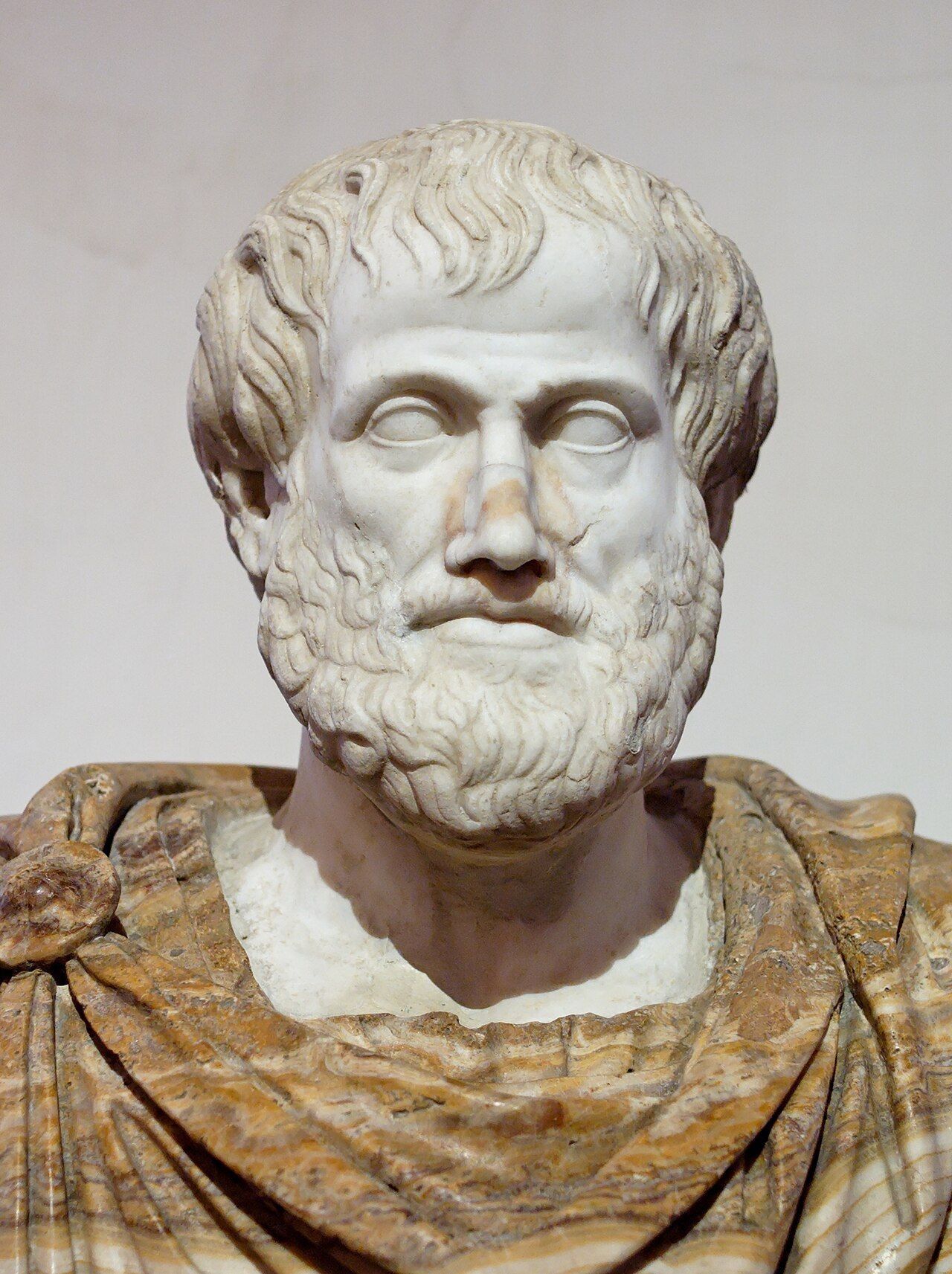

Man is naturally a political animal.
Born in Stagira in northern Greece, Aristotle studied at Plato’s Academy and later founded his own school, the Lyceum. Unlike Plato, he located the forms of things within the things themselves, and he placed great weight on careful observation. His logic remained the standard for two thousand years, and his ethics — centred on virtue and human flourishing (eudaimonia) — is still widely studied.
His work was transmitted to the medieval world largely through Arabic philosophers, who called him simply “the First Teacher”.
Key ideas
- The first logic
- Aristotle was the first to set out the rules of valid reasoning systematically. His theory of deduction, known today as syllogistic, came with a logic of the possible and the necessary.
- The four causes
- To explain something fully we must give four causes, the “because”s behind it. These are what it’s made of (the bronze of a statue), its form, what brought it about (the sculptor) and its end, the purpose it serves.
- Form and matter
- Ordinary objects such as houses, horses and humans are composites of matter and form. This answers Parmenides’ challenge to the reality of change: whenever something changes, one thing stays while another is acquired or lost.
- Happiness as flourishing (eudaimonia)
- The highest human good is eudaimonia, achieved by fully realising our nature and developing our human capacities to the highest degree. It consists in living by reason, and is not a matter of personal taste.
- Political animals
- Human beings are by nature political animals, who can flourish only within an organised city (polis). The city “comes into being for the sake of living, but it remains in existence for the sake of living well”.
- Tradition
- Western
- Region
- Athens
- Period
- Ancient Greek and Roman
Influences
Influenced by
- Anaxagorasc. 500 – 428 BCE
- Parmenidesfl. 500–450 BCEcriticised
- Empedoclesfl. 470–430 BCEcriticised
- Zeno of Eleafl. 465–440 BCEcriticised
- Platoc. 429 – 347 BCEteacher, criticised
Aristotle384–322 BCE
Influenced
Before 500 CE
- Chrysippusc. 280 – c. 207 BCEcritic
- Cicero106–43 BCE
- Plotinusc. 204 – 270 CE
- Proclus412–485 CEcritic
- Boethiusc. 476 – c. 526 CE
500 CE – 1400
- al-Kindic. 800 – c. 870 CE
- al-Farabic. 870 – c. 950 CE
- Avicennac. 970 – 1037 CE
- Avempacebefore 1085 – 1139
- Averroes1126–1198
- Maimonides1138–1204
- Bonaventurec. 1221 – 1274critic
- Thomas Aquinasc. 1225 – 1274
- John Duns Scotusc. 1265 – 1308
- William of Ockhamc. 1287 – 1347
- Gersonides1288–1344
- Hasdai Crescasc. 1340 – c. 1410critic
1400 – 1800
- Giordano Bruno1548–1600critic
- Francis Bacon1561–1626critic
- Thomas Hobbes1588–1679critic
- René Descartes1596–1650critic
- Adam Smith1723–1790
- G. W. F. Hegel1770–1831
1800 – 1900
Influenced by
- Anaxagorasc. 500 – 428 BCE
- Parmenidesfl. 500–450 BCEcriticised
- Empedoclesfl. 470–430 BCEcriticised
- Zeno of Eleafl. 465–440 BCEcriticised
- Platoc. 429 – 347 BCEteacher, criticised
Aristotle384–322 BCE
Influenced
Before 500 CE
- Chrysippusc. 280 – c. 207 BCEcritic
- Cicero106–43 BCE
- Plotinusc. 204 – 270 CE
- Proclus412–485 CEcritic
- Boethiusc. 476 – c. 526 CE
500 CE – 1400
- al-Kindic. 800 – c. 870 CE
- al-Farabic. 870 – c. 950 CE
- Avicennac. 970 – 1037 CE
- Avempacebefore 1085 – 1139
- Averroes1126–1198
- Maimonides1138–1204
- Bonaventurec. 1221 – 1274critic
- Thomas Aquinasc. 1225 – 1274
- John Duns Scotusc. 1265 – 1308
- William of Ockhamc. 1287 – 1347
- Gersonides1288–1344
- Hasdai Crescasc. 1340 – c. 1410critic
1400 – 1800
- Giordano Bruno1548–1600critic
- Francis Bacon1561–1626critic
- Thomas Hobbes1588–1679critic
- René Descartes1596–1650critic
- Adam Smith1723–1790
- G. W. F. Hegel1770–1831
1800 – 1900
Where these links come from
- Aristotle argued against Parmenides. Source: Christopher Shields, Aristotle, Stanford Encyclopedia of Philosophy
- Aristotle drew on Anaxagoras. Source: John Sisko and Patricia Curd, Anaxagoras, Stanford Encyclopedia of Philosophy
- Aristotle drew on and argued against Empedocles. Source: K. Scarlett Kingsley and Richard Parry, Empedocles, Stanford Encyclopedia of Philosophy
- Aristotle argued against Zeno of Elea. Source: John Palmer, Zeno of Elea, Stanford Encyclopedia of Philosophy
- Aristotle studied with and argued against Plato. Source: Christopher Shields, Aristotle, Stanford Encyclopedia of Philosophy
- Chrysippus drew on and argued against Aristotle. Source: Jeremy Kirby, Chrysippus, Internet Encyclopedia of Philosophy
- Cicero drew on Aristotle. Source: Raphael Woolf, Cicero, Stanford Encyclopedia of Philosophy
- Plotinus drew on Aristotle. Source: Paul Kalligas, Plotinus, Stanford Encyclopedia of Philosophy
- Proclus drew on and argued against Aristotle. Source: Christoph Helmig and Carlos Steel, Proclus, Stanford Encyclopedia of Philosophy
- Boethius drew on Aristotle. Source: John Marenbon, Anicius Manlius Severinus Boethius, Stanford Encyclopedia of Philosophy
- al-Kindi drew on Aristotle. Source: Peter Adamson, al-Kindi, Stanford Encyclopedia of Philosophy
- al-Farabi drew on Aristotle. Source: Therese-Anne Druart, al-Farabi, Stanford Encyclopedia of Philosophy
- Avicenna drew on Aristotle. Source: Dimitri Gutas, Ibn Sina [Avicenna], Stanford Encyclopedia of Philosophy
- Avempace drew on Aristotle. Source: Josep Puig Montada, Ibn Bâjja [Avempace], Stanford Encyclopedia of Philosophy
- Averroes drew on Aristotle. Source: Fouad Ben Ahmed and Robert Pasnau, Ibn Rushd [Averroes], Stanford Encyclopedia of Philosophy
- Maimonides drew on Aristotle. Source: Kenneth Seeskin, Maimonides, Stanford Encyclopedia of Philosophy
- Bonaventure drew on and argued against Aristotle. Source: Tim Noone, R. E. Houser and Joshua Benson, Bonaventure, Stanford Encyclopedia of Philosophy
- Thomas Aquinas drew on Aristotle. Source: Robert Pasnau, Thomas Aquinas, Stanford Encyclopedia of Philosophy
- John Duns Scotus drew on Aristotle. Source: Thomas Williams, John Duns Scotus, Stanford Encyclopedia of Philosophy
- William of Ockham drew on Aristotle. Source: Paul Vincent Spade, Claude Panaccio and Jenny Pelletier, William of Ockham, Stanford Encyclopedia of Philosophy
- Gersonides drew on Aristotle. Source: Tamar Rudavsky, Gersonides, Stanford Encyclopedia of Philosophy
- Hasdai Crescas argued against Aristotle. Source: Shalom Sadik, Hasdai Crescas, Stanford Encyclopedia of Philosophy
- Giordano Bruno argued against Aristotle. Source: Dilwyn Knox, Giordano Bruno, Stanford Encyclopedia of Philosophy
- Francis Bacon argued against Aristotle. Source: Markku Peltonen, Francis Bacon, Stanford Encyclopedia of Philosophy
- Thomas Hobbes argued against Aristotle. Source: Stewart Duncan, Thomas Hobbes, Stanford Encyclopedia of Philosophy
- René Descartes drew on and argued against Aristotle. Source: Gary Hatfield, René Descartes, Stanford Encyclopedia of Philosophy
- Adam Smith drew on Aristotle. Source: Samuel Fleischacker, Adam Smith's Moral and Political Philosophy, Stanford Encyclopedia of Philosophy
- G. W. F. Hegel drew on Aristotle. Source: Paul Redding, Georg Wilhelm Friedrich Hegel, Stanford Encyclopedia of Philosophy
- Nishida Kitarō drew on Aristotle. Source: John C. Maraldo, Nishida Kitarō, Stanford Encyclopedia of Philosophy
- Martin Heidegger drew on Aristotle. Source: Mark Wrathall, Martin Heidegger, Stanford Encyclopedia of Philosophy
Key works
- Nicomachean Ethics
- Read free at Project Gutenberg (Everyman's Library edition)
- Metaphysics
- Politics
- Read free at Project Gutenberg (translated by William Ellis)
Sources
- Christopher Shields, Aristotle, Stanford Encyclopedia of Philosophy
- K. Scarlett Kingsley and Richard Parry, Empedocles, Stanford Encyclopedia of Philosophy
- John Sisko and Patricia Curd, Anaxagoras, Stanford Encyclopedia of Philosophy
- John Palmer, Zeno of Elea, Stanford Encyclopedia of Philosophy