Philosopher
René Descartes
1596–1650
Also known as Renatus Cartesius, Rene Descartes
Often called the father of modern philosophy, he sought certain foundations for knowledge through methodical doubt and the insight 'I think, therefore I am'.
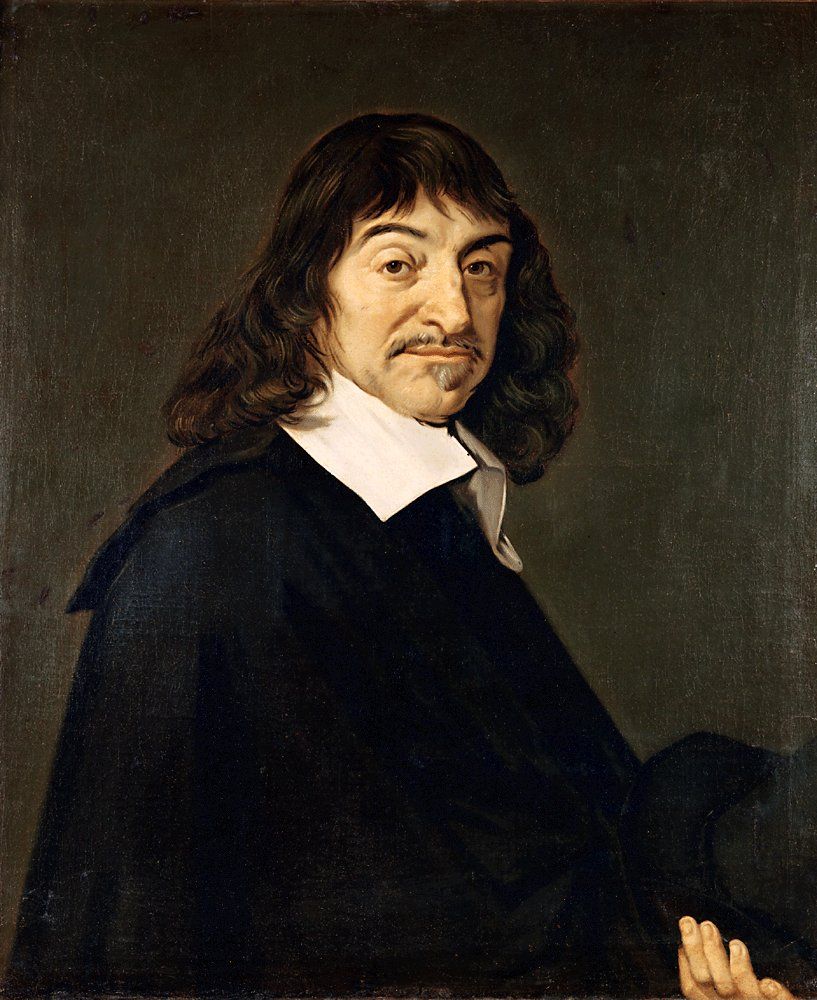

I think, therefore I am.
Descartes resolved to doubt everything that could possibly be doubted, and found one thing he could not: that he himself, while doubting, was thinking and so existed. From this starting point he attempted to rebuild knowledge on secure foundations. He drew a sharp distinction between mind, a thinking thing, and matter, an extended thing — a dualism that set the terms of the mind–body problem.
He was also a major mathematician, and one of the inventors of analytic geometry.
Key ideas
- The method of doubt
- To find a secure foundation for knowledge, Descartes doubted everything he had learned through the senses. We might be dreaming, or an evil deceiver might be making us err even when we reason.
- “I think, therefore I am”
- Even while doubting everything else, Descartes couldn’t doubt that he himself existed, since doubting is thinking. The cogito is known with certainty because it is perceived “clearly and distinctly”.
- Clear and distinct perception
- Clear and distinct perception by the intellect, independent of the senses, is the mark of truth. This reversed the scholastic slogan that nothing is in the intellect that wasn’t first in the senses.
- Mind and body
- Mind is a substance whose whole nature is to think, and it needs no place or material thing to exist. Matter is a substance whose essence is extension in length, breadth and depth. The two are distinct substances.
- The mechanical world
- For Descartes the natural world, animal bodies included, is a machine that runs purely by the laws of matter. His physics and physiology were admired for centuries.
- Tradition
- Western
- Region
- France and the Dutch Republic
- Schools
- Rationalism
- Period
- Early modern
Influences
Influenced by
René Descartes1596–1650
Influenced
1400 – 1800
- Thomas Hobbes1588–1679critic
- Baruch Spinoza1632–1677
- John Locke1632–1704
- Nicolas Malebranche1638–1715
- Gottfried Wilhelm Leibniz1646–1716critic
- George Berkeley1685–1753critic
1800 – 1900
1900 onwards
Influenced by
René Descartes1596–1650
Influenced
1400 – 1800
- Thomas Hobbes1588–1679critic
- Baruch Spinoza1632–1677
- John Locke1632–1704
- Nicolas Malebranche1638–1715
- Gottfried Wilhelm Leibniz1646–1716critic
- George Berkeley1685–1753critic
1800 – 1900
1900 onwards
Where these links come from
- René Descartes drew on and argued against Aristotle. Source: Gary Hatfield, René Descartes, Stanford Encyclopedia of Philosophy
- René Descartes drew on Michel de Montaigne. Source: Marc Foglia and Emiliano Ferrari, Michel de Montaigne, Stanford Encyclopedia of Philosophy
- Thomas Hobbes argued against René Descartes. Source: Stewart Duncan, Thomas Hobbes, Stanford Encyclopedia of Philosophy
- Baruch Spinoza drew on René Descartes. Source: Steven Nadler, Baruch Spinoza, Stanford Encyclopedia of Philosophy
- John Locke drew on René Descartes. Source: William Uzgalis, John Locke, Stanford Encyclopedia of Philosophy
- Nicolas Malebranche drew on René Descartes. Source: Tad Schmaltz, Nicolas Malebranche, Stanford Encyclopedia of Philosophy
- Gottfried Wilhelm Leibniz argued against René Descartes. Source: Brandon C. Look, Gottfried Wilhelm Leibniz, Stanford Encyclopedia of Philosophy
- George Berkeley argued against René Descartes. Source: Lisa Downing and David Hilbert, George Berkeley, Stanford Encyclopedia of Philosophy
- Edmund Husserl drew on and argued against René Descartes. Source: Dan Zahavi, Edmund Husserl, Stanford Encyclopedia of Philosophy
- Martin Heidegger argued against René Descartes. Source: Mark Wrathall, Martin Heidegger, Stanford Encyclopedia of Philosophy
- Simone de Beauvoir drew on René Descartes. Source: Debra Bergoffen and Megan Burke, Simone de Beauvoir, Stanford Encyclopedia of Philosophy
- Simone Weil drew on René Descartes. Source: A. Rebecca Rozelle-Stone and Benjamin P. Davis, Simone Weil, Stanford Encyclopedia of Philosophy
Key works
- Discourse on the Method (Discours de la méthode), 1637
- Read free at Project Gutenberg (translated by John Veitch)
- Meditations on First Philosophy (Meditationes de prima philosophia), 1641
- Read free at Standard Ebooks (translated by John Veitch, in Philosophical Works)
Sources
- Gary Hatfield, René Descartes, Stanford Encyclopedia of Philosophy
- Marc Foglia and Emiliano Ferrari, Michel de Montaigne, Stanford Encyclopedia of Philosophy