Philosopher
Martin Heidegger
1889–1976
German philosopher whose Being and Time asked what it means to be, and shaped existentialism, phenomenology and much of later European thought.
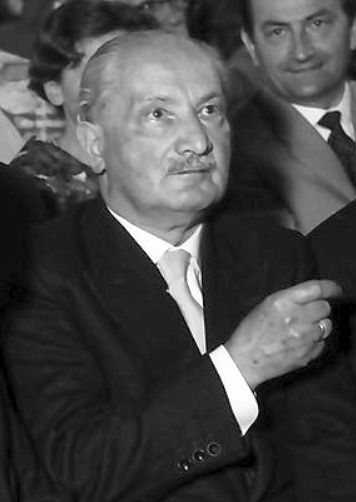
.jpg)
Martin Heidegger taught at the University of Freiburg, where in 1919 he became the assistant of Edmund Husserl, the founder of phenomenology. His magnum opus, Being and Time (1927), asks the question of the meaning of being, approaching it through an analysis of human existence (Dasein) as always already engaged in a world, facing death, and living authentically or inauthentically. It deeply influenced Sartre’s existentialism, Beauvoir’s feminism, Merleau-Ponty and others.
In 1933, shortly after Hitler came to power, Heidegger became rector of Freiburg University and joined the Nazi Party. He resigned the rectorship a year later but remained a party member until the end of the regime. The significance of this engagement, and of his well-documented antisemitism, for his philosophy is hotly disputed. His later work turned to the history of being and the dangers of modern technology.
Key ideas
- The question of being
- Heidegger’s driving question was the meaning of being. He held that there are several distinct kinds of being, and that our understanding of being is structured by time.
- Dasein and being-in-the-world
- Heidegger called human beings Dasein, the entities that have an understanding of being. We are not detached minds but beings-in-the-world, constituted by our practical and social involvements.
- Ready-to-hand
- We first encounter most things as “available” (ready-to-hand), usable for some task, like a hammer, rather than as objects to be observed. Even the sun shows up first as something to tell the time by, and to light and warm us.
- “The anyone”
- Our everyday understanding of the world is shaped by shared social norms, aims and tastes. Heidegger calls this das Man, “the anyone”, because in following it we act as anyone would.
- Technology
- In the technological age, everything, humans included, shows up as “stock”, a resource held in reserve and valued for being replaceable.
- Tradition
- Western
- Region
- Freiburg, Germany
- Schools
- Phenomenology
- Period
- Contemporary
Influences
Influenced by
- Aristotle384–322 BCE
- René Descartes1596–1650criticised
- Immanuel Kant1724–1804criticised
- Søren Kierkegaard1813–1855
- Friedrich Nietzsche1844–1900
- Edmund Husserl1859–1938teacher, criticised
Martin Heidegger1889–1976
Influenced
1800 – 1900
1900 onwards
Influenced by
- Aristotle384–322 BCE
- René Descartes1596–1650criticised
- Immanuel Kant1724–1804criticised
- Søren Kierkegaard1813–1855
- Friedrich Nietzsche1844–1900
- Edmund Husserl1859–1938teacher, criticised
Martin Heidegger1889–1976
Influenced
1800 – 1900
1900 onwards
Where these links come from
- Martin Heidegger drew on Aristotle. Source: Mark Wrathall, Martin Heidegger, Stanford Encyclopedia of Philosophy
- Martin Heidegger argued against René Descartes. Source: Mark Wrathall, Martin Heidegger, Stanford Encyclopedia of Philosophy
- Martin Heidegger drew on and argued against Immanuel Kant. Source: Mark Wrathall, Martin Heidegger, Stanford Encyclopedia of Philosophy
- Martin Heidegger drew on Søren Kierkegaard. Source: Mark Wrathall, Martin Heidegger, Stanford Encyclopedia of Philosophy
- Martin Heidegger drew on Friedrich Nietzsche. Source: Mark Wrathall, Martin Heidegger, Stanford Encyclopedia of Philosophy
- Martin Heidegger studied with, drew on and argued against Edmund Husserl. Source: Mark Wrathall, Martin Heidegger, Stanford Encyclopedia of Philosophy
- Tanabe Hajime studied with Martin Heidegger. Source: Bret W. Davis, The Kyoto School, Stanford Encyclopedia of Philosophy
- Watsuji Tetsurō drew on and argued against Martin Heidegger. Source: Robert Carter and Erin McCarthy, Watsuji Tetsurō, Stanford Encyclopedia of Philosophy
- Nishitani Keiji studied with, drew on and argued against Martin Heidegger. Source: Bret W. Davis, The Kyoto School, Stanford Encyclopedia of Philosophy
- Theodor W. Adorno argued against Martin Heidegger. Source: Henry Pickford and Lambert Zuidervaart, Theodor W. Adorno, Stanford Encyclopedia of Philosophy
- Jean-Paul Sartre drew on Martin Heidegger. Source: Jack Reynolds and Pierre-Jean Renaudie, Jean-Paul Sartre, Stanford Encyclopedia of Philosophy
- Hannah Arendt studied with and drew on Martin Heidegger. Source: Tatjana Tömmel and Maurizio Passerin d’Entrèves, Hannah Arendt, Stanford Encyclopedia of Philosophy
- Maurice Merleau-Ponty drew on Martin Heidegger. Source: Ted Toadvine, Maurice Merleau-Ponty, Stanford Encyclopedia of Philosophy
- Simone de Beauvoir drew on Martin Heidegger. Source: Debra Bergoffen and Megan Burke, Simone de Beauvoir, Stanford Encyclopedia of Philosophy
- Albert Camus argued against Martin Heidegger. Source: Ronald Aronson, Albert Camus, Stanford Encyclopedia of Philosophy
- Michel Foucault drew on Martin Heidegger. Source: Gary Gutting and Johanna Oksala, Michel Foucault, Stanford Encyclopedia of Philosophy
- Jürgen Habermas argued against Martin Heidegger. Source: James Gordon Finlayson and Dafydd Huw Rees, Jürgen Habermas, Stanford Encyclopedia of Philosophy
- Jacques Derrida drew on and argued against Martin Heidegger. Source: Leonard Lawlor, Jacques Derrida, Stanford Encyclopedia of Philosophy
Key works
- Being and Time (Sein und Zeit), 1927
Sources
- Mark Wrathall, Martin Heidegger, Stanford Encyclopedia of Philosophy