Philosopher
Zeno of Elea
fl. 465–440 BCE
Also known as Zeno the Eleatic, Zenon
Parmenides' younger associate, famous for paradoxes, among them Achilles and the tortoise, that draw contradictions out of common beliefs about plurality and motion.
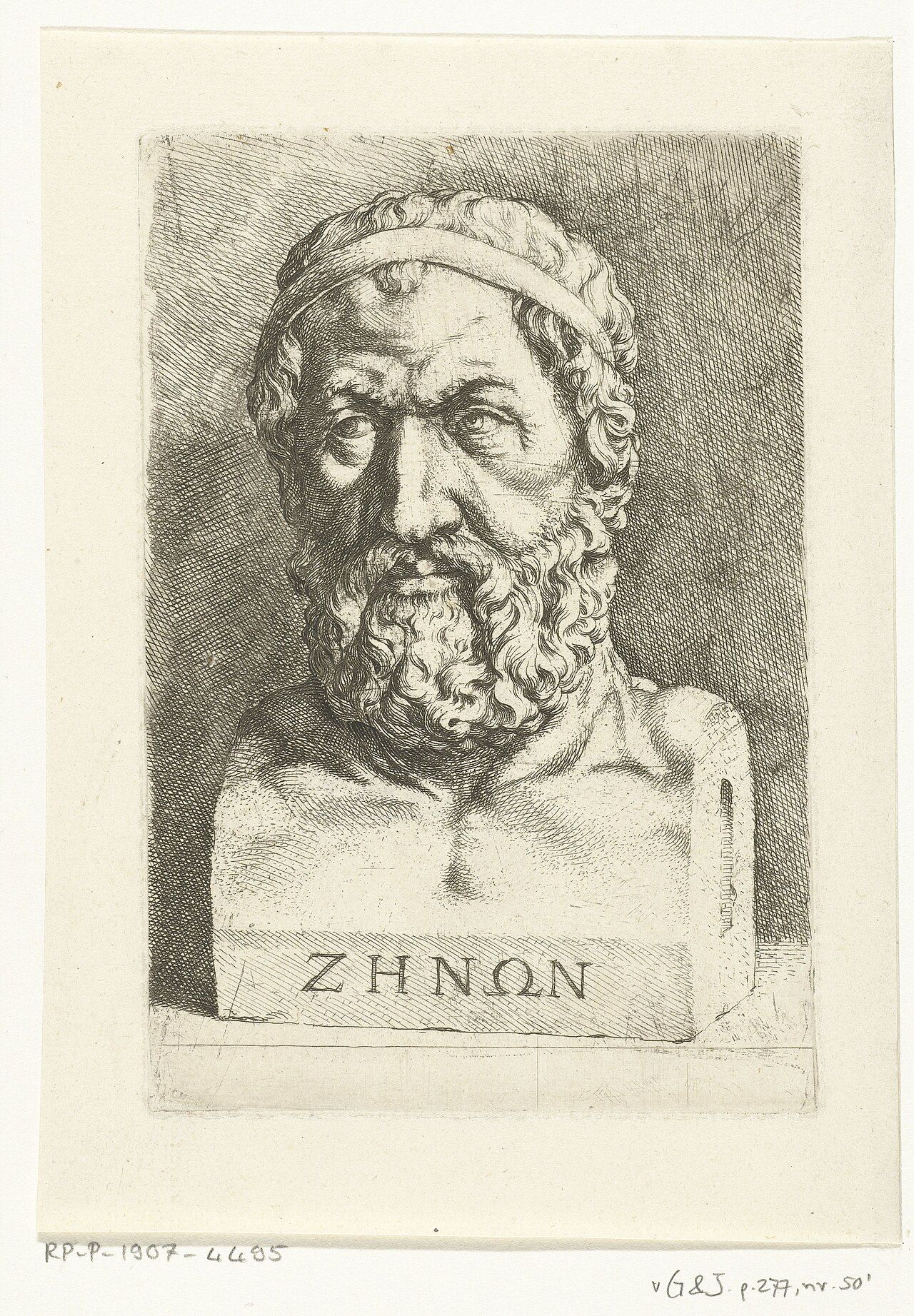
,_RP-P-1907-4495.jpg)
If things are a many, they must be just as many as they are, and neither more nor less. Now, if they are as many as they are, they will be finite in number.
The slowest runner never will be overtaken by the fastest; for it is necessary for the one chasing to come first to where the one fleeing started from, so that it is necessary for the slower runner always to be ahead some.
Almost nothing reliable is known of Zeno’s life. Plato’s Parmenides imagines him visiting Athens at nearly forty, with Parmenides, then about sixty-five, and reading his book to the young Socrates; this suggests he was born around 490 BCE. He seems to have been active in the Greek cities of southern Italy in the mid-fifth century, and stories of his part in a plot against a local tyrant cannot be checked. His arguments caught on quickly: a drinking cup from about his lifetime shows a hero running ahead of a large tortoise.
He appears to have written a single book of arguments, each deriving contradictions from ordinary assumptions. Only a few are known, most through Aristotle, who discusses four arguments against motion in his Physics. He is usually said to have been defending Parmenides’ view that all is one, but in Plato’s dialogue Zeno himself says only that he turned the mockery of Parmenides’ critics back on them. His paradoxes may also have been aimed at Pythagorean attempts to describe the physical world in mathematical terms. Philosophers, mathematicians and physicists have been answering them ever since.
Key ideas
- Against plurality
- If there are many things, there must be exactly as many as there are, and so a limited number. But between any two things there is always another, and others between those, so their number is unlimited. So believing in a plurality of things ends in contradiction.
- The race-course
- To cross a stadium you must first reach the halfway point, and before that the point halfway to it, and so on without end. Reaching an unlimited number of points in a limited time seems impossible, so it seems nothing can move from one place to another.
- Achilles and the tortoise
- The fastest runner can never catch the slowest. Each time Achilles reaches the spot where the tortoise was, it has moved a little further on, so the tortoise always stays ahead.
- The arrow
- At every instant a flying arrow occupies a space equal to itself, and so is at rest. If time is made up of such instants, the arrow never moves. Aristotle replied that time is not composed of indivisible instants.
- Tradition
- Western
- Region
- Elea, southern Italy
- Period
- Ancient Greek and Roman
- Themes
- What is ultimately real
Influences
Influenced by
Zeno of Eleafl. 465–440 BCE
Influenced
Influenced by
Zeno of Eleafl. 465–440 BCE
Influenced
Where these links come from
- Zeno of Elea drew on Parmenides. Source: John Palmer, Zeno of Elea, Stanford Encyclopedia of Philosophy
- Aristotle argued against Zeno of Elea. Source: John Palmer, Zeno of Elea, Stanford Encyclopedia of Philosophy
Key works
- The book of arguments (lost)
Sources
- John Palmer, Zeno of Elea, Stanford Encyclopedia of Philosophy