Philosopher
Plato
c. 429 – 347 BCE
Student of Socrates and founder of the Academy, whose dialogues range across ethics, politics, knowledge and reality, and introduce the theory of Forms.
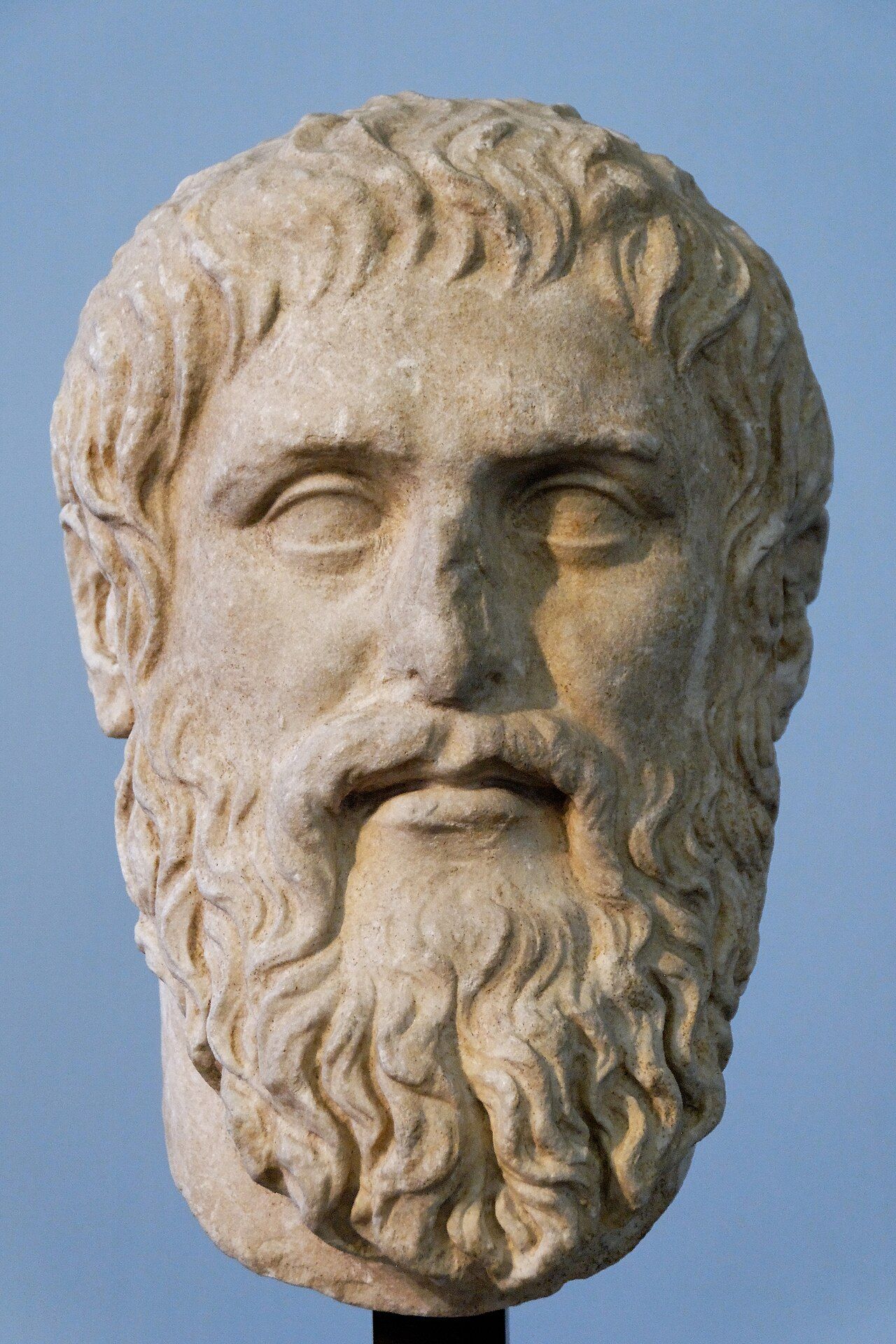

Until philosophers are kings, or the kings and princes of this world have the spirit and power of philosophy, and political greatness and wisdom meet in one, … cities will never have rest from their evils.
Plato wrote dialogues rather than treatises, most of them with Socrates as the main speaker. Across them he developed the view that the changing world we perceive is less real than eternal, unchanging Forms — such as Justice or the Good — which can be known only through reason. In the Republic he connects this to a picture of the just soul and the just city, famously ruled by philosopher-kings.
Around 387 BCE he founded the Academy in Athens, where Aristotle studied for twenty years.
Key ideas
- The forms
- Beyond the defective world of the senses is a more real realm of eternal, changeless forms, such as goodness, beauty and equality. The many beautiful things we see get their character from the one thing that beauty really is.
- The soul and the body
- The soul differs in kind from the body. It can work without the body, and it grasps the forms much more readily when it is not bound to anything bodily.
- Learning as recollection
- In some dialogues, especially the Meno, learning is the soul recollecting what it grasped of the forms before birth, when it was not yet embodied.
- The form of the good
- Knowing what is good, and why, requires inquiry into the form of the good. Yet the Republic admits that its true nature remains something of a mystery.
- Philosophy as dialogue
- Plato wrote dialogues, most often with Socrates as the leading speaker. They rarely just advocate fixed doctrines, and often raise unanswered puzzles about the very views they recommend.
- Tradition
- Western
- Region
- Athens
- Schools
- Platonism
- Period
- Ancient Greek and Roman
Influences
Influenced by
- Heraclitusfl. 510–490 BCE
- Anaxagorasc. 500 – 428 BCEcriticised
- Parmenidesfl. 500–450 BCE
- Protagorasc. 490 – c. 420 BCEcriticised
- Socratesc. 470 – 399 BCEteacher
Platoc. 429 – 347 BCE
Influenced
Before 500 CE
- Diogenes of Sinopec. 404 – c. 323 BCEcritic
- Aristotle384–322 BCEstudent, critic
- Cicero106–43 BCE
- Marcus Aurelius121–180 CE
- Plotinusc. 204 – 270 CE
- Augustine354–430 CE
- Proclus412–485 CE
500 CE – 1400
- al-Kindic. 800 – c. 870 CE
- Abu Bakr al-Razi865–925 CE
- al-Farabic. 870 – c. 950 CE
- Avempacebefore 1085 – 1139
- Averroes1126–1198critic
- Suhrawardi1154–1191
1400 – 1800
- Desiderius Erasmus1469–1536
- Niccolò Machiavelli1469–1527critic
- Jean-Jacques Rousseau1712–1778
- Arthur Schopenhauer1788–1860
1800 – 1900
1900 onwards
Influenced by
- Heraclitusfl. 510–490 BCE
- Anaxagorasc. 500 – 428 BCEcriticised
- Parmenidesfl. 500–450 BCE
- Protagorasc. 490 – c. 420 BCEcriticised
- Socratesc. 470 – 399 BCEteacher
Platoc. 429 – 347 BCE
Influenced
Before 500 CE
- Diogenes of Sinopec. 404 – c. 323 BCEcritic
- Aristotle384–322 BCEstudent, critic
- Cicero106–43 BCE
- Marcus Aurelius121–180 CE
- Plotinusc. 204 – 270 CE
- Augustine354–430 CE
- Proclus412–485 CE
500 CE – 1400
- al-Kindic. 800 – c. 870 CE
- Abu Bakr al-Razi865–925 CE
- al-Farabic. 870 – c. 950 CE
- Avempacebefore 1085 – 1139
- Averroes1126–1198critic
- Suhrawardi1154–1191
1400 – 1800
- Desiderius Erasmus1469–1536
- Niccolò Machiavelli1469–1527critic
- Jean-Jacques Rousseau1712–1778
- Arthur Schopenhauer1788–1860
1800 – 1900
1900 onwards
Where these links come from
- Plato drew on Heraclitus. Source: Daniel W. Graham, Heraclitus, Stanford Encyclopedia of Philosophy
- Plato drew on Parmenides. Source: John Palmer, Parmenides, Stanford Encyclopedia of Philosophy
- Plato drew on and argued against Anaxagoras. Source: John Sisko and Patricia Curd, Anaxagoras, Stanford Encyclopedia of Philosophy
- Plato argued against Protagoras. Source: Mauro Bonazzi, Protagoras, Stanford Encyclopedia of Philosophy
- Plato studied with and drew on Socrates. Source: Richard Kraut, Plato, Stanford Encyclopedia of Philosophy
- Diogenes of Sinope argued against Plato. Source: Julie Piering, Diogenes of Sinope, Internet Encyclopedia of Philosophy
- Aristotle studied with and argued against Plato. Source: Christopher Shields, Aristotle, Stanford Encyclopedia of Philosophy
- Cicero drew on Plato. Source: Raphael Woolf, Cicero, Stanford Encyclopedia of Philosophy
- Marcus Aurelius drew on Plato. Source: Rachana Kamtekar, Marcus Aurelius, Stanford Encyclopedia of Philosophy
- Plotinus drew on Plato. Source: Paul Kalligas, Plotinus, Stanford Encyclopedia of Philosophy
- Augustine drew on Plato. Source: Christian Tornau, Augustine of Hippo, Stanford Encyclopedia of Philosophy
- Proclus drew on Plato. Source: Christoph Helmig and Carlos Steel, Proclus, Stanford Encyclopedia of Philosophy
- al-Kindi drew on Plato. Source: Peter Adamson, al-Kindi, Stanford Encyclopedia of Philosophy
- Abu Bakr al-Razi drew on Plato. Source: Peter Adamson, Abu Bakr al-Razi, Stanford Encyclopedia of Philosophy
- al-Farabi drew on Plato. Source: Therese-Anne Druart, al-Farabi, Stanford Encyclopedia of Philosophy
- Avempace drew on Plato. Source: Josep Puig Montada, Ibn Bâjja [Avempace], Stanford Encyclopedia of Philosophy
- Averroes drew on and argued against Plato. Source: Fouad Ben Ahmed and Robert Pasnau, Ibn Rushd [Averroes], Stanford Encyclopedia of Philosophy
- Suhrawardi drew on Plato. Source: Roxanne Marcotte, Suhrawardi, Stanford Encyclopedia of Philosophy
- Desiderius Erasmus drew on Plato. Source: Erika Rummel and Eric MacPhail, Desiderius Erasmus, Stanford Encyclopedia of Philosophy
- Niccolò Machiavelli argued against Plato. Source: Cary Nederman, Niccolò Machiavelli, Stanford Encyclopedia of Philosophy
- Jean-Jacques Rousseau drew on Plato. Source: Christopher Bertram, Jean Jacques Rousseau, Stanford Encyclopedia of Philosophy
- Arthur Schopenhauer drew on Plato. Source: Robert Wicks, Arthur Schopenhauer, Stanford Encyclopedia of Philosophy
- Nishida Kitarō drew on Plato. Source: John C. Maraldo, Nishida Kitarō, Stanford Encyclopedia of Philosophy
- Simone Weil drew on Plato. Source: A. Rebecca Rozelle-Stone and Benjamin P. Davis, Simone Weil, Stanford Encyclopedia of Philosophy
- Iris Murdoch drew on Plato. Source: Lawrence Blum, Iris Murdoch, Stanford Encyclopedia of Philosophy
Key works
- Republic (Politeia)
- Read free at Project Gutenberg (translated by Benjamin Jowett)
- Symposium
- Read free at Project Gutenberg (translated by Benjamin Jowett)
- Phaedo
- Read free at Project Gutenberg (translated by Benjamin Jowett)
Often attributed, but not said
Be kind, for everyone you meet is fighting a hard battle.
Traced to the Scottish writer Ian Maclaren, whose 1898 Christmas message read “Be pitiful, for every man is fighting a hard battle”. Source: Be Kind; Everyone You Meet is Fighting a Hard Battle, Quote Investigator
Sources
- Richard Kraut, Plato, Stanford Encyclopedia of Philosophy
- John Sisko and Patricia Curd, Anaxagoras, Stanford Encyclopedia of Philosophy
- Mauro Bonazzi, Protagoras, Stanford Encyclopedia of Philosophy
- Daniel W. Graham, Heraclitus, Stanford Encyclopedia of Philosophy
- John Palmer, Parmenides, Stanford Encyclopedia of Philosophy