Philosopher
Thomas Aquinas
c. 1225 – 1274
Dominican friar and theologian who combined Aristotle's philosophy with Christian doctrine in the most influential synthesis of medieval scholasticism.
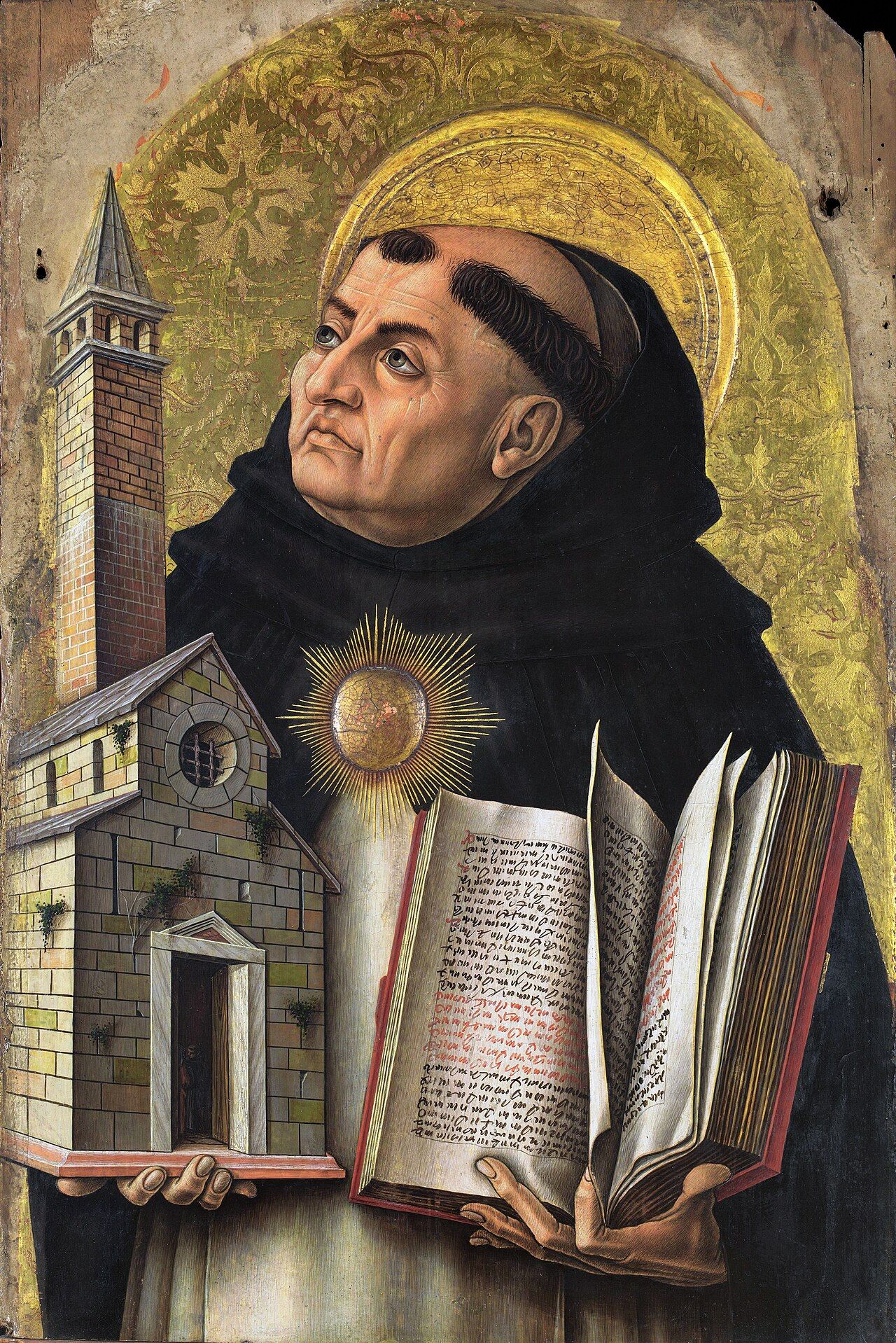

The existence of God can be proved in five ways.
Thomas Aquinas taught at the University of Paris and in Italy during the decades when Aristotle’s works, newly available in Latin, were transforming European thought. He argued that reason and faith cannot truly conflict, and built a comprehensive system in which Aristotelian philosophy supports and clarifies Christian theology. He engaged closely with Arabic commentators on Aristotle, especially Avicenna and Averroes.
Key ideas
- The five ways
- Natural reason can prove that God exists. Aquinas’s “five ways” argue that everything in the changing world depends on a first cause, or prime mover. He rejected Anselm’s ontological argument.
- Natural law
- Rational beings share in God’s eternal law through the natural law, which is innate within us. Human laws are particular developments of it, worked out by human reason.
- The soul as the form of the body
- Following Aristotle, the soul is the first principle of life, the “substantial form” of a living thing, not a separate spiritual thing lodged in it. Plants and animals have souls in this sense too.
- Happiness as the vision of God
- Every choice aims at one ultimate end, happiness. It isn’t riches, honour or pleasure but contemplation, and “final and complete happiness can consist in nothing other than the vision of the divine essence”.
- Tradition
- Western
- Region
- Italy and Paris
- Schools
- Scholasticism
- Period
- Medieval
Influences
Influenced by
- Aristotle384–322 BCE
- Augustine354–430 CE
- Boethiusc. 476 – c. 526 CE
- Avicennac. 970 – 1037 CE
- Anselm of Canterbury1033–1109criticised
- Averroes1126–1198criticised
Thomas Aquinasc. 1225 – 1274
Influenced
Influenced by
- Aristotle384–322 BCE
- Augustine354–430 CE
- Boethiusc. 476 – c. 526 CE
- Avicennac. 970 – 1037 CE
- Anselm of Canterbury1033–1109criticised
- Averroes1126–1198criticised
Thomas Aquinasc. 1225 – 1274
Influenced
Where these links come from
- Thomas Aquinas drew on Aristotle. Source: Robert Pasnau, Thomas Aquinas, Stanford Encyclopedia of Philosophy
- Thomas Aquinas drew on Augustine. Source: Robert Pasnau, Thomas Aquinas, Stanford Encyclopedia of Philosophy
- Thomas Aquinas drew on Boethius. Source: Robert Pasnau, Thomas Aquinas, Stanford Encyclopedia of Philosophy
- Thomas Aquinas drew on Avicenna. Source: Robert Pasnau, Thomas Aquinas, Stanford Encyclopedia of Philosophy
- Thomas Aquinas argued against Anselm of Canterbury. Source: Robert Pasnau, Thomas Aquinas, Stanford Encyclopedia of Philosophy
- Thomas Aquinas drew on and argued against Averroes. Source: Robert Pasnau, Thomas Aquinas, Stanford Encyclopedia of Philosophy
- Meister Eckhart drew on Thomas Aquinas. Source: Amber L. Griffioen, Meister Eckhart, Stanford Encyclopedia of Philosophy
- John Duns Scotus drew on and argued against Thomas Aquinas. Source: Thomas Williams, John Duns Scotus, Stanford Encyclopedia of Philosophy
Key works
- Summa Theologiae
- Read free at Project Gutenberg (translated by the Fathers of the English Dominican Province, first of four parts)
- Summa contra Gentiles
Sources
- Robert Pasnau, Thomas Aquinas, Stanford Encyclopedia of Philosophy