Philosopher
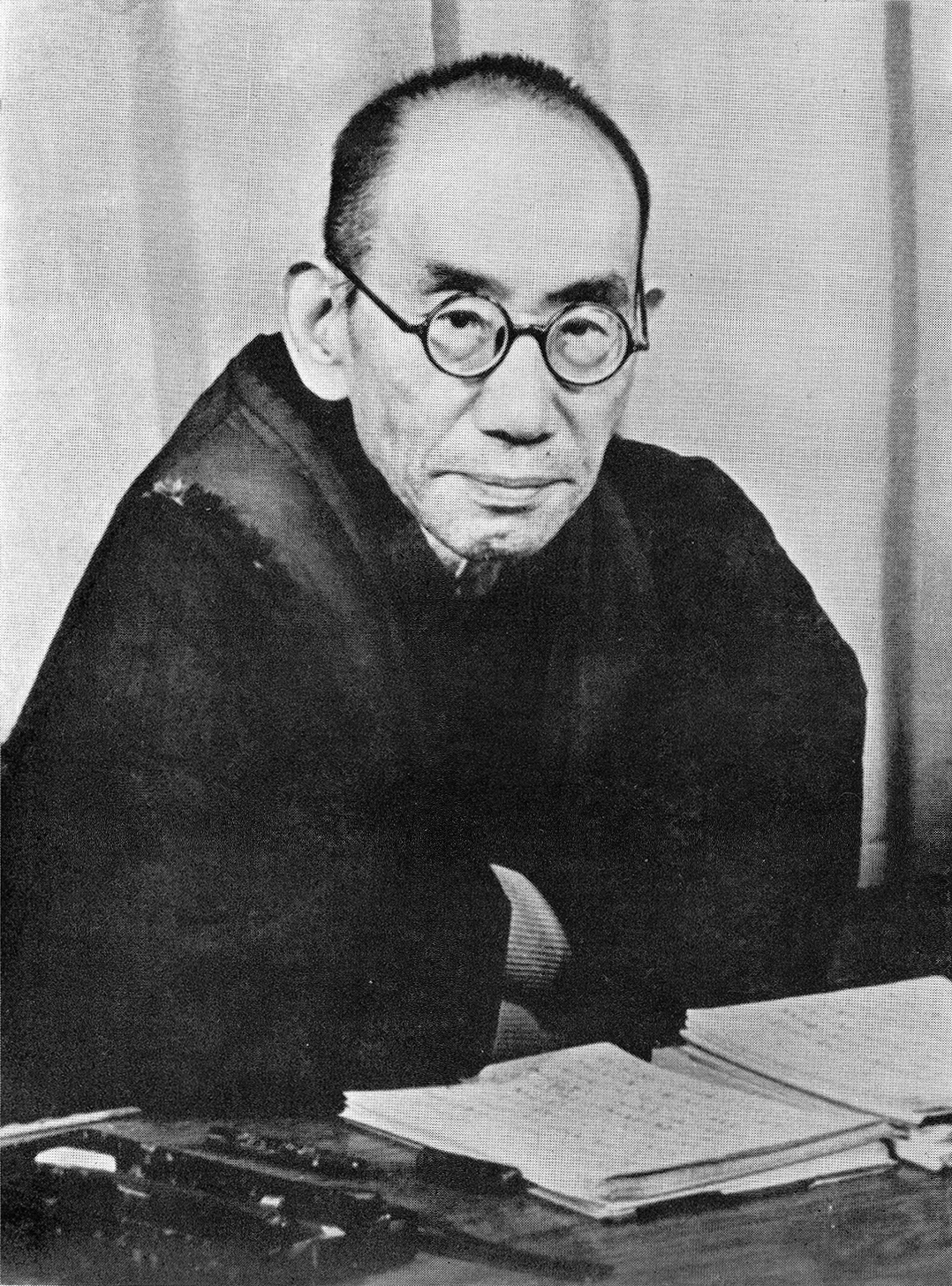
Nishida Kitarō
1870–1945
Also known as Kitarō Nishida, Kitaro Nishida
The most influential Japanese philosopher of the twentieth century, founder of the Kyoto School, who grounded self and world in 'pure experience' and in the place of absolute nothingness.

The bottom of my soul has such depth; / Neither joy nor the waves of sorrow can reach it.
Nishida was born in 1870 near Kanazawa, on the Sea of Japan, as Japan opened to the West. At school he read the Confucian and Daoist classics and began to learn English and German, and formed a lifelong friendship with D. T. Suzuki. He studied Kant, Hegel and Schopenhauer at Tokyo Imperial University as a “limited status” student, wrote his graduation thesis on Hume’s account of causality, and spent the next decade teaching in provincial schools while practising Zen meditation.
An Inquiry into the Good won him a post at Kyoto Imperial University in 1910, and he became professor there in 1914. He brought Tanabe Hajime and Watsuji Tetsurō to Kyoto and taught students such as Nishitani Keiji, and the group around him became known as the Kyoto School. In the late 1930s government officials called on him to justify Japanese nationalism; he addressed the issues, if not legitimising Japan’s expansionism, and his critics on the right found him too abstract or not supportive enough. He died in June 1945, two months after completing his last essay, The Logic of Place and the Religious Worldview.
Key ideas
- Pure experience
- Experience in its original form comes before any split into a subject who experiences and an object experienced; the individual is formed out of it. Pure experience is the “one and only reality”, and recovering this unity is what Nishida means by the Good.
- The logic of place
- Everything we perceive or think is “in” a wider context that places it, as particulars are placed in universals. The world mirrors itself in all the things in it, and the individual self is a “focal point” of the world rather than a mind set over against it.
- Absolute nothingness
- The ultimate place within which all reality occurs is absolute nothingness. It is not a being beyond the world, like God or a transcendental ego, but is active and creative, determining itself “without anything that does the determining” and embracing every particular determination.
- Action-intuition
- Seeing and making are not opposites. As an artist takes in the world and forms it anew, and is formed in turn, so we shape the historical world as it shapes us; Nishida called such opposites that are one a “self-identity of contradictories”.
- The self and the absolute
- Religion arises when we know our own death. The closer the finite self comes to God, the sharper the difference between them grows; God embraces the self, but the self never dissolves into God.
- Tradition
- Japanese
- Region
- Kyoto
- Schools
- Kyoto School
- Period
- Modern Japanese
Influences
Influenced by
Nishida Kitarō1870–1945
Influenced
Influenced by
Nishida Kitarō1870–1945
Influenced
Where these links come from
- Nishida Kitarō drew on Plato. Source: John C. Maraldo, Nishida Kitarō, Stanford Encyclopedia of Philosophy
- Nishida Kitarō drew on Aristotle. Source: John C. Maraldo, Nishida Kitarō, Stanford Encyclopedia of Philosophy
- Nishida Kitarō drew on Edmund Husserl. Source: John C. Maraldo, Nishida Kitarō, Stanford Encyclopedia of Philosophy
- Tanabe Hajime drew on and argued against Nishida Kitarō. Source: Bret W. Davis, The Kyoto School, Stanford Encyclopedia of Philosophy
- Watsuji Tetsurō drew on Nishida Kitarō. Source: Bret W. Davis, The Kyoto School, Stanford Encyclopedia of Philosophy
- Nishitani Keiji drew on Nishida Kitarō. Source: Bret W. Davis, The Kyoto School, Stanford Encyclopedia of Philosophy
Key works
- An Inquiry into the Good (Zen no kenkyū), 1911
- Intuition and Reflection in Self-Consciousness, 1917
- The Logic of Place and the Religious Worldview, 1945
Sources
- John C. Maraldo, Nishida Kitarō, Stanford Encyclopedia of Philosophy
- Bret W. Davis, The Kyoto School, Stanford Encyclopedia of Philosophy