Philosopher
al-Farabi
c. 870 – c. 950 CE
Also known as Abu Nasr al-Farabi, Alpharabius
Called the 'Second Teacher' after Aristotle, he established the Arabic tradition of Aristotelian logic and wrote on the ideal, virtuous city.
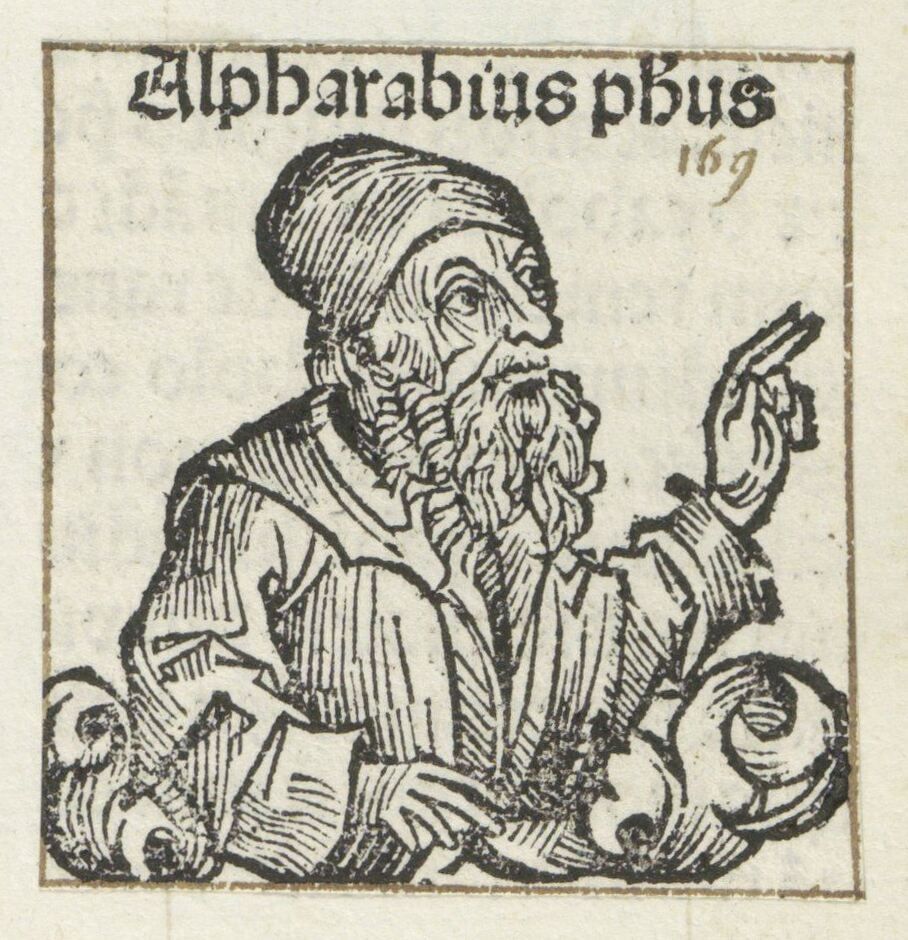
_Liber_Chronicarum_(serietitel),_RP-P-2016-49-86-16.jpg)
Al-Fārābī worked mainly in Baghdad, and later in Damascus, where he died. He wrote extensive commentaries on Aristotle’s logic and was so highly regarded that he became known as the “Second Teacher”, after Aristotle. In his political philosophy he drew on Plato’s Republic to describe a virtuous city led by a philosopher-ruler, and asked how philosophy relates to religion.
Key ideas
- Logic as the path to happiness
- Known as “the second master” after Aristotle, al-Farabi made logic central to philosophy and saw it as the path to happiness. He urged students to curb their passions and begin their studies with logic.
- The perfect city
- In works such as The Opinions of the People of the Perfect City, the ordered hierarchy of the ideal state mirrors the hierarchy of a universe that emanates in descending levels. His political thought draws on Plato’s Republic and Laws but transforms them.
- Metaphysics as the study of being
- In The Aims of Aristotle’s Metaphysics, al-Farabi insisted that metaphysics is not mainly theology. It investigates what all existing things have in common, such as being and unity.
- Happiness as union with the intellect
- In several works al-Farabi held that ultimate happiness is the human intellect’s conjunction with the Agent Intellect. Later philosophers reported that a lost commentary of his dismissed this as a tall tale.
- Free will and foreknowledge
- Taking up Aristotle’s problem of statements about the future, al-Farabi considered God’s foreknowledge too, and defended human free will against some theologians.
- Tradition
- Arabic and Islamic
- Region
- Baghdad and Damascus
- Period
- Classical Islamic
Influences
Influenced by
al-Farabic. 870 – c. 950 CE
Influenced
Influenced by
al-Farabic. 870 – c. 950 CE
Influenced
Where these links come from
- al-Farabi drew on Plato. Source: Therese-Anne Druart, al-Farabi, Stanford Encyclopedia of Philosophy
- al-Farabi drew on Aristotle. Source: Therese-Anne Druart, al-Farabi, Stanford Encyclopedia of Philosophy
- Avicenna drew on al-Farabi. Source: Olga Lizzini, Ibn Sina’s Metaphysics, Stanford Encyclopedia of Philosophy
- Avempace drew on al-Farabi. Source: Josep Puig Montada, Ibn Bâjja [Avempace], Stanford Encyclopedia of Philosophy
- Averroes drew on and argued against al-Farabi. Source: Fouad Ben Ahmed and Robert Pasnau, Ibn Rushd [Averroes], Stanford Encyclopedia of Philosophy
- Maimonides drew on al-Farabi. Source: Kenneth Seeskin, Maimonides, Stanford Encyclopedia of Philosophy
Key works
- The Virtuous City (Mabadi' ara' ahl al-madina al-fadila)
Sources
- Therese-Anne Druart, al-Farabi, Stanford Encyclopedia of Philosophy