Philosopher
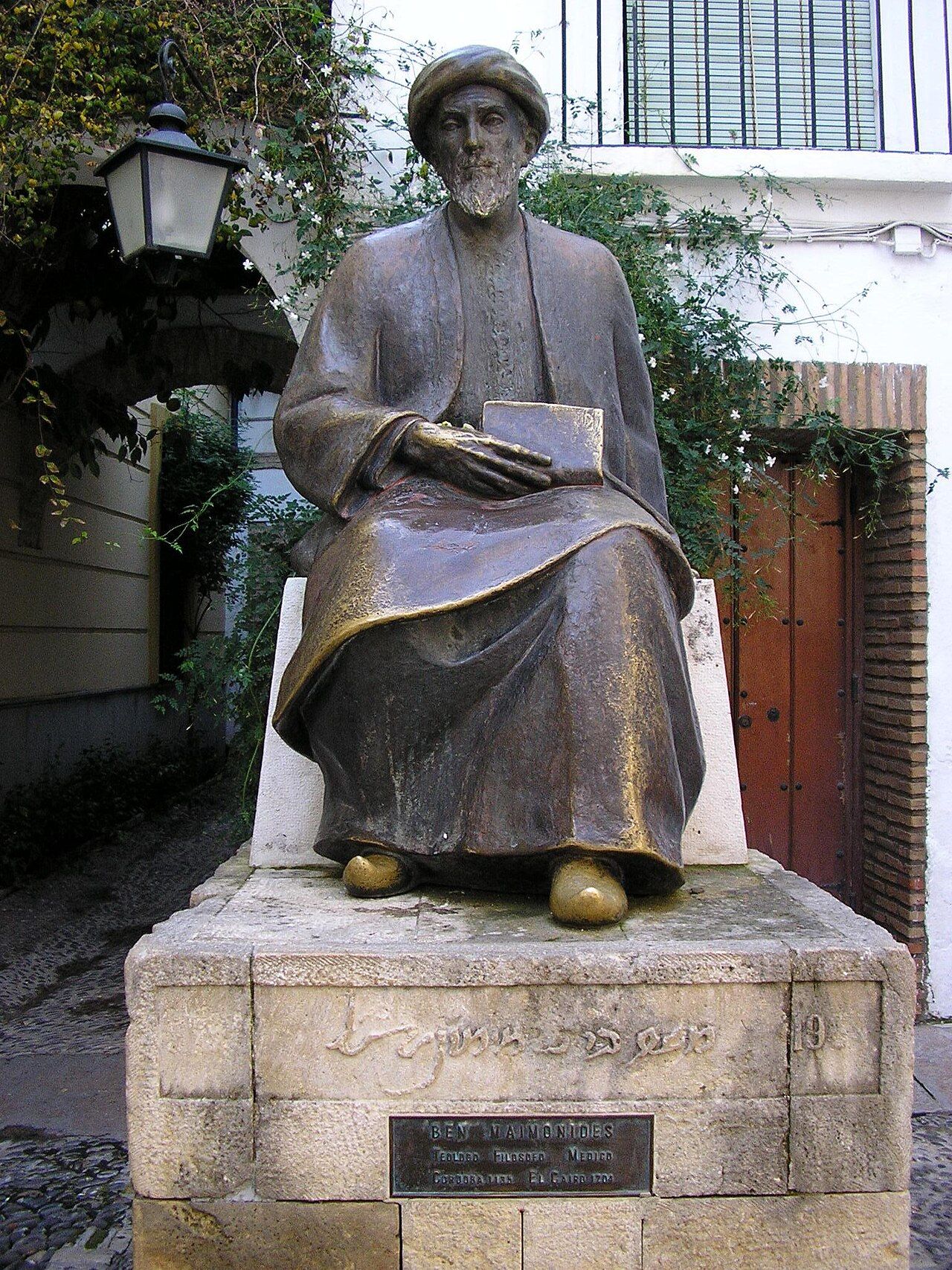
Maimonides
1138–1204
Also known as Moses Maimonides, Moses ben Maimon, Rambam
Rabbi, physician and the greatest Jewish philosopher of the Middle Ages, whose Guide of the Perplexed reconciles scripture with Aristotelian philosophy while stressing the limits of human knowledge.

Know that the negative attributes of God are the true attributes: they do not include any incorrect notions or any deficiency whatever in reference to God, while positive attributes imply polytheism, and are inadequate.
Maimonides was born in 1138 in Córdoba, then under Muslim rule and also the birthplace of Averroes. When the Almohads invaded, his family was forced to leave; they reached Fez in 1160, and in 1166 Maimonides arrived in Egypt and settled in Fustat, part of Cairo, where he died in 1204. He was famous as a physician as well as a rabbi.
His Mishneh Torah, a code of Jewish law in fourteen volumes, made him the foremost rabbinic authority of his day. In his Commentary on the Mishnah he listed thirteen principles that he considered binding on every Jew, the first attempt to give Judaism articles of faith. His philosophical masterpiece, the Guide of the Perplexed, completed in 1190, is addressed to an advanced student torn between philosophy and religion. It was banned in some rabbinic circles, and it shaped thinkers as different as Aquinas, Spinoza, Leibniz and Newton.
Key ideas
- God is known by negation
- God is absolutely one, with no plurality of attributes, so we cannot say what God is. “God is powerful” is true only as a disguised negation, that God does not lack power, not because God’s power is like ours but greater.
- Against a literal reading of scripture
- The greatest obstacle to loving God is reading the Bible literally, which leads to a bodily conception of God that amounts to idolatry. Much of the Guide explains biblical terms that seem to give God a body.
- Creation cannot be proved
- Neither the creation of the world nor its eternity can be demonstrated by reason alone; one can only tip the scales. Maimonides says he prefers the view of Moses, creation from nothing, and allows Plato’s creation from pre-existing matter as a reasonable alternative.
- The law perfects body and soul
- Every commandment serves a rational purpose; nothing is given only for the sake of obedience. The whole of Jewish law aims at the welfare of the body as a means to the perfection of the soul, which comes through true knowledge and ends in the love of God.
- Writing for different readers
- Scripture speaks to readers of different levels, and Maimonides says he will contradict himself on purpose in the Guide. Whether his words hide a deeper, more radical meaning has been debated ever since.
- Tradition
- Jewish
- Region
- Al-Andalus, Morocco and Egypt
- Period
- Judaeo-Arabic
Influences
Influenced by
Maimonides1138–1204
Influenced
Influenced by
Maimonides1138–1204
Influenced
Where these links come from
- Maimonides drew on Aristotle. Source: Kenneth Seeskin, Maimonides, Stanford Encyclopedia of Philosophy
- Maimonides drew on al-Farabi. Source: Kenneth Seeskin, Maimonides, Stanford Encyclopedia of Philosophy
- Meister Eckhart drew on Maimonides. Source: Amber L. Griffioen, Meister Eckhart, Stanford Encyclopedia of Philosophy
- Gersonides drew on and argued against Maimonides. Source: Tamar Rudavsky, Gersonides, Stanford Encyclopedia of Philosophy
- Hasdai Crescas drew on and argued against Maimonides. Source: Shalom Sadik, Hasdai Crescas, Stanford Encyclopedia of Philosophy
- Baruch Spinoza drew on Maimonides. Source: Steven Nadler, Baruch Spinoza, Stanford Encyclopedia of Philosophy
Key works
- The Guide of the Perplexed (Dalalat al-ha'irin), 1190
- Read free at Project Gutenberg (translated by M. Friedländer)
- Read free at Wikisource (in Hebrew, translated by Samuel ibn Tibbon, the medieval Hebrew translation)
- Mishneh Torah
- Commentary on the Mishnah, 1168
Sources
- Kenneth Seeskin, Maimonides, Stanford Encyclopedia of Philosophy