Philosopher
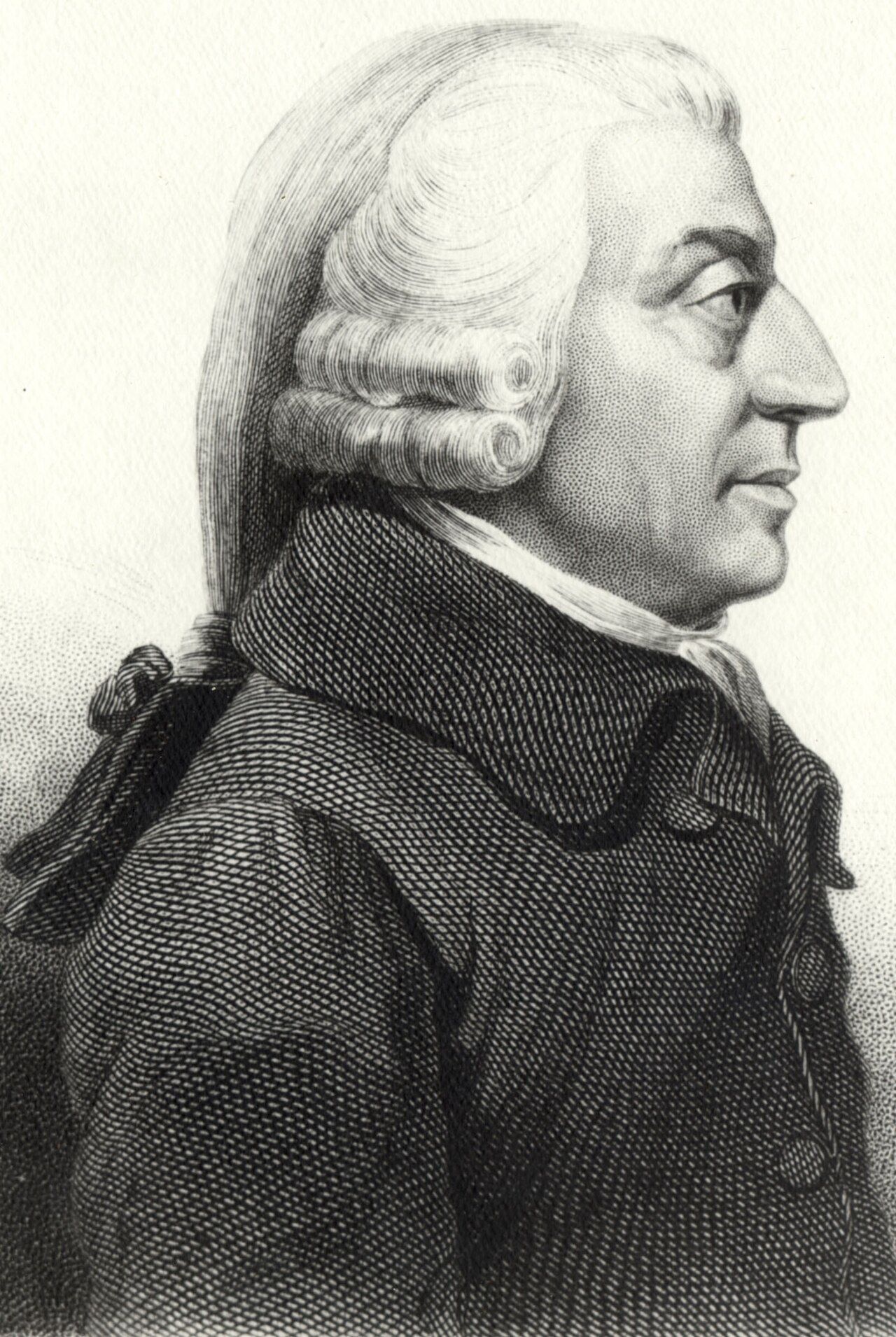
Adam Smith
1723–1790
Scottish moral philosopher who grounded ethics in sympathy and an imagined impartial spectator, and whose _Wealth of Nations_ defended the natural liberty of ordinary people to run their affairs.

How selfish soever man may be supposed, there are evidently some principles in his nature, which interest him in the fortune of others, and render their happiness necessary to him, though he derives nothing from it, except the pleasure of seeing it.
It is not from the benevolence of the butcher, the brewer, or the baker that we expect our dinner, but from their regard to their own interest.
Adam Smith was born in Kirkcaldy, on the east coast of Scotland, in June 1723, after his father’s death. He studied at Glasgow, where he admired his teacher Francis Hutcheson, and then at Balliol College, Oxford, which he disliked. After public lectures in Edinburgh he became professor of logic at Glasgow in 1751 and of moral philosophy the next year, and there wrote The Theory of Moral Sentiments (1759). David Hume became his closest friend. In 1764 he left to tutor the young Duke of Buccleuch, spending two years in France among the philosophes, and then returned to Kirkcaldy to write The Wealth of Nations (1776). In 1778 he moved to Edinburgh as a commissioner of customs, and he died in 1790.
He is often called the father of modern capitalism, but he never used the word, and his subject was political economy, a mix of philosophy, history and social theory. He thought The Theory of Moral Sentiments the better book and kept revising it. The old claim that its sympathetic ethics contradicts a selfish economics in The Wealth of Nations is now rejected by most scholars.
Key ideas
- Sympathy
- We sympathise with others by imagining how we would feel in their place, so our feelings for them never quite match theirs. We constantly adjust our feelings, as spectators and as those affected, to reach a level others can share, and this process gives rise to virtue.
- The impartial spectator
- Actual onlookers are often ignorant or biased, so we judge by the feelings a well-informed, impartial spectator would have. A feeling deserves moral approval if such a spectator would sympathise with it, and the virtuous person comes to take that spectator’s view as their own.
- Ordinary judgement over systems
- Moral theory should be built from the judgements people actually make, not imposed from a philosophical height. Likewise, people are not pieces on a chessboard; those who design grand political systems forget that each person has their own principle of motion.
- Natural liberty in the economy
- Business is best left to those who know their own circumstances, and government should end the favours it grants to particular trades. People trading out of self-interest serve one another well, but merchants must be kept out of government, and the state may help the poor.
- Tradition
- Western
- Region
- Kirkcaldy; Glasgow; Edinburgh
- Period
- Early modern
Influences
Influenced by
Adam Smith1723–1790
Influenced by
Adam Smith1723–1790
Where these links come from
- Adam Smith drew on Aristotle. Source: Samuel Fleischacker, Adam Smith's Moral and Political Philosophy, Stanford Encyclopedia of Philosophy
- Adam Smith argued against Thomas Hobbes. Source: Jack Russell Weinstein, Adam Smith, Internet Encyclopedia of Philosophy
- Adam Smith drew on and argued against David Hume. Source: Samuel Fleischacker, Adam Smith's Moral and Political Philosophy, Stanford Encyclopedia of Philosophy
Key works
- The Theory of Moral Sentiments
- An Inquiry into the Nature and Causes of the Wealth of Nations
- Essays on Philosophical Subjects
- Read free at Project Gutenberg (as The Essays of Adam Smith)
Sources
- Samuel Fleischacker, Adam Smith's Moral and Political Philosophy, Stanford Encyclopedia of Philosophy
- Jack Russell Weinstein, Adam Smith, Internet Encyclopedia of Philosophy