Philosopher
G. W. F. Hegel
1770–1831
Also known as Georg Wilhelm Friedrich Hegel
The most systematic of the German idealists, who saw reality and history as the unfolding of spirit, and whose dialectical method shaped much of later philosophy.
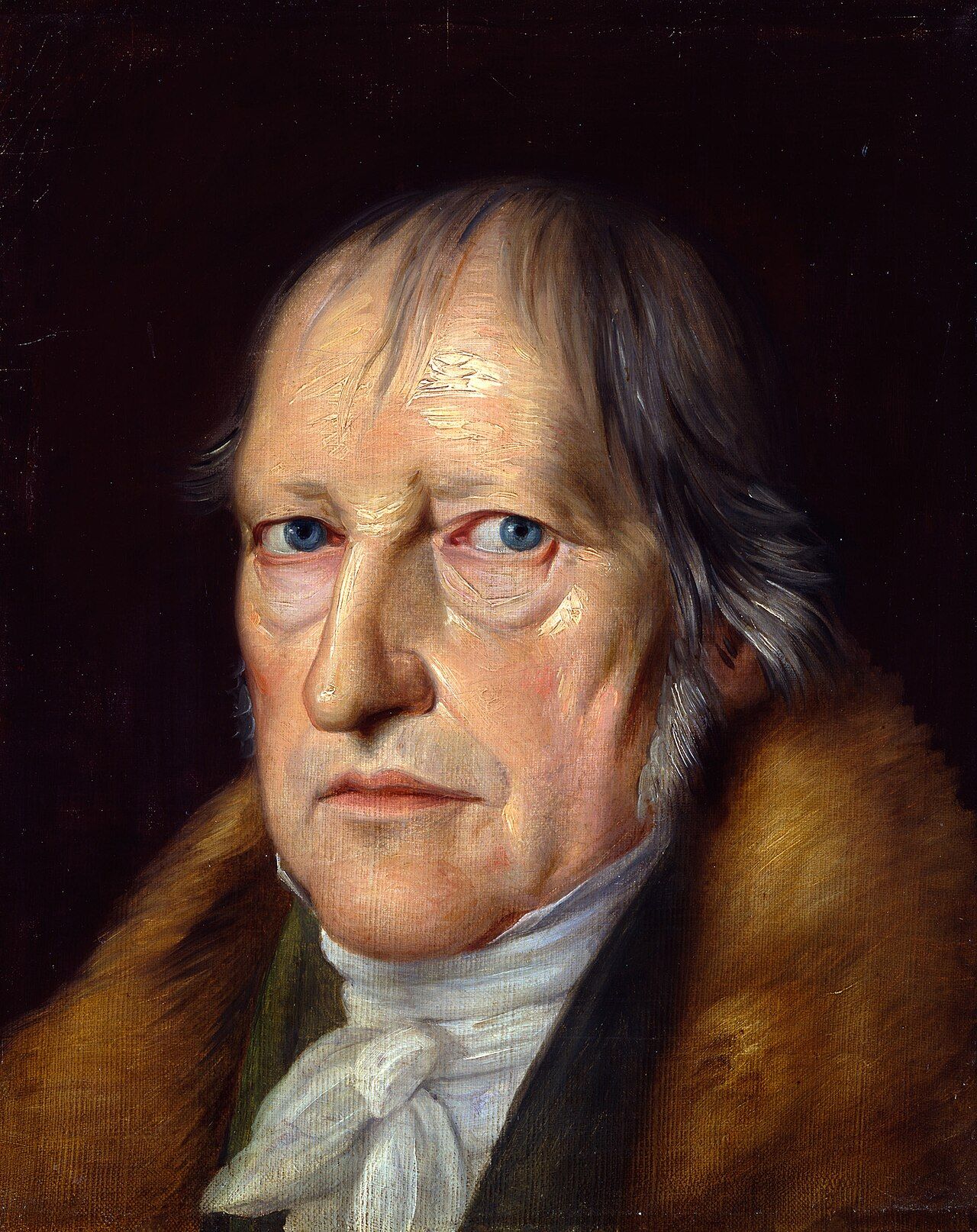

Georg Wilhelm Friedrich Hegel belongs to the generation of German idealists who followed Kant. He taught at Jena, Heidelberg and finally Berlin. The Phenomenology of Spirit (1807) traces the development of consciousness through ever more adequate forms of knowing, up to philosophical knowledge itself.
The most systematic of the idealists, Hegel tried to build a comprehensive philosophy from a purportedly logical starting point, in which nature, history, society, art, religion and philosophy are all stages in the self-realisation of “spirit” (Geist). His ideas, including the view that history has a rational structure, shaped thinkers as different as Marx and Kierkegaard, who both developed their own views in response to him.
Key ideas
- A system from logic
- The most systematic of the German idealists, Hegel tried to build a comprehensive philosophy from a purportedly logical starting point, set out in works such as the Science of Logic and his Encyclopaedia.
- The struggle for recognition
- Self-consciousness depends on others. I become a self-conscious subject only by recognising others who in turn recognise me, and these patterns of mutual recognition make up “spirit” (Geist).
- Sublation
- In Hegel’s triads, the third term integrates the first two. They are “sublated” (aufgehoben), negated but also preserved, so they go on working within the new context the third creates.
- Ethical life (Sittlichkeit)
- Social life is ordered by customs and shared practices. Hegel’s account of spirit starts from this “ethical order”, ways of life that exist only as the people who share them live them out.
- History as development
- Hegel is best known for his teleological account of history, in which spirit develops through a necessary sequence of stages. Marx later “inverted” it into a materialist theory of history.
- Tradition
- Western
- Region
- Jena, Heidelberg and Berlin
- Period
- Late modern
Influences
Influenced by
- Aristotle384–322 BCE
- Baruch Spinoza1632–1677
- Jean-Jacques Rousseau1712–1778criticised
- Immanuel Kant1724–1804
G. W. F. Hegel1770–1831
Influenced
1800 – 1900
- Søren Kierkegaard1813–1855critic
- Karl Marx1818–1883critic
- John Dewey1859–1952
- Bertrand Russell1872–1970critic
- Tanabe Hajime1885–1962
1900 onwards
Influenced by
- Aristotle384–322 BCE
- Baruch Spinoza1632–1677
- Jean-Jacques Rousseau1712–1778criticised
- Immanuel Kant1724–1804
G. W. F. Hegel1770–1831
Influenced
1800 – 1900
- Søren Kierkegaard1813–1855critic
- Karl Marx1818–1883critic
- John Dewey1859–1952
- Bertrand Russell1872–1970critic
- Tanabe Hajime1885–1962
1900 onwards
Where these links come from
- G. W. F. Hegel drew on Aristotle. Source: Paul Redding, Georg Wilhelm Friedrich Hegel, Stanford Encyclopedia of Philosophy
- G. W. F. Hegel drew on Baruch Spinoza. Source: Paul Redding, Georg Wilhelm Friedrich Hegel, Stanford Encyclopedia of Philosophy
- G. W. F. Hegel drew on and argued against Jean-Jacques Rousseau. Source: Paul Redding, Georg Wilhelm Friedrich Hegel, Stanford Encyclopedia of Philosophy
- G. W. F. Hegel drew on Immanuel Kant. Source: Paul Redding, Georg Wilhelm Friedrich Hegel, Stanford Encyclopedia of Philosophy
- Søren Kierkegaard drew on and argued against G. W. F. Hegel. Source: John Lippitt and C. Stephen Evans, Søren Kierkegaard, Stanford Encyclopedia of Philosophy
- Karl Marx drew on and argued against G. W. F. Hegel. Source: Jonathan Wolff and David Leopold, Karl Marx, Stanford Encyclopedia of Philosophy
- John Dewey drew on G. W. F. Hegel. Source: David Hildebrand, John Dewey, Stanford Encyclopedia of Philosophy
- Bertrand Russell argued against G. W. F. Hegel. Source: Andrew David Irvine, Bertrand Russell, Stanford Encyclopedia of Philosophy
- Tanabe Hajime drew on G. W. F. Hegel. Source: Bret W. Davis, The Kyoto School, Stanford Encyclopedia of Philosophy
- Theodor W. Adorno drew on and argued against G. W. F. Hegel. Source: Henry Pickford and Lambert Zuidervaart, Theodor W. Adorno, Stanford Encyclopedia of Philosophy
- Jean-Paul Sartre drew on G. W. F. Hegel. Source: Jack Reynolds and Pierre-Jean Renaudie, Jean-Paul Sartre, Stanford Encyclopedia of Philosophy
- Simone de Beauvoir drew on G. W. F. Hegel. Source: Debra Bergoffen and Megan Burke, Simone de Beauvoir, Stanford Encyclopedia of Philosophy
- Michel Foucault drew on G. W. F. Hegel. Source: Gary Gutting and Johanna Oksala, Michel Foucault, Stanford Encyclopedia of Philosophy
- Jacques Derrida drew on G. W. F. Hegel. Source: Leonard Lawlor, Jacques Derrida, Stanford Encyclopedia of Philosophy
Key works
- Phenomenology of Spirit (Phänomenologie des Geistes), 1807
- Read free at Project Gutenberg (in German)
- Science of Logic (Wissenschaft der Logik)
- Read free at Project Gutenberg (in German, volume 1 of 2)
- Elements of the Philosophy of Right (Grundlinien der Philosophie des Rechts)
Sources
- Paul Redding, Georg Wilhelm Friedrich Hegel, Stanford Encyclopedia of Philosophy