Philosopher
Plotinus
c. 204 – 270 CE
Founder of Neoplatonism, who taught that all reality flows from a single, indescribable source, the One, and that the soul can return to it.
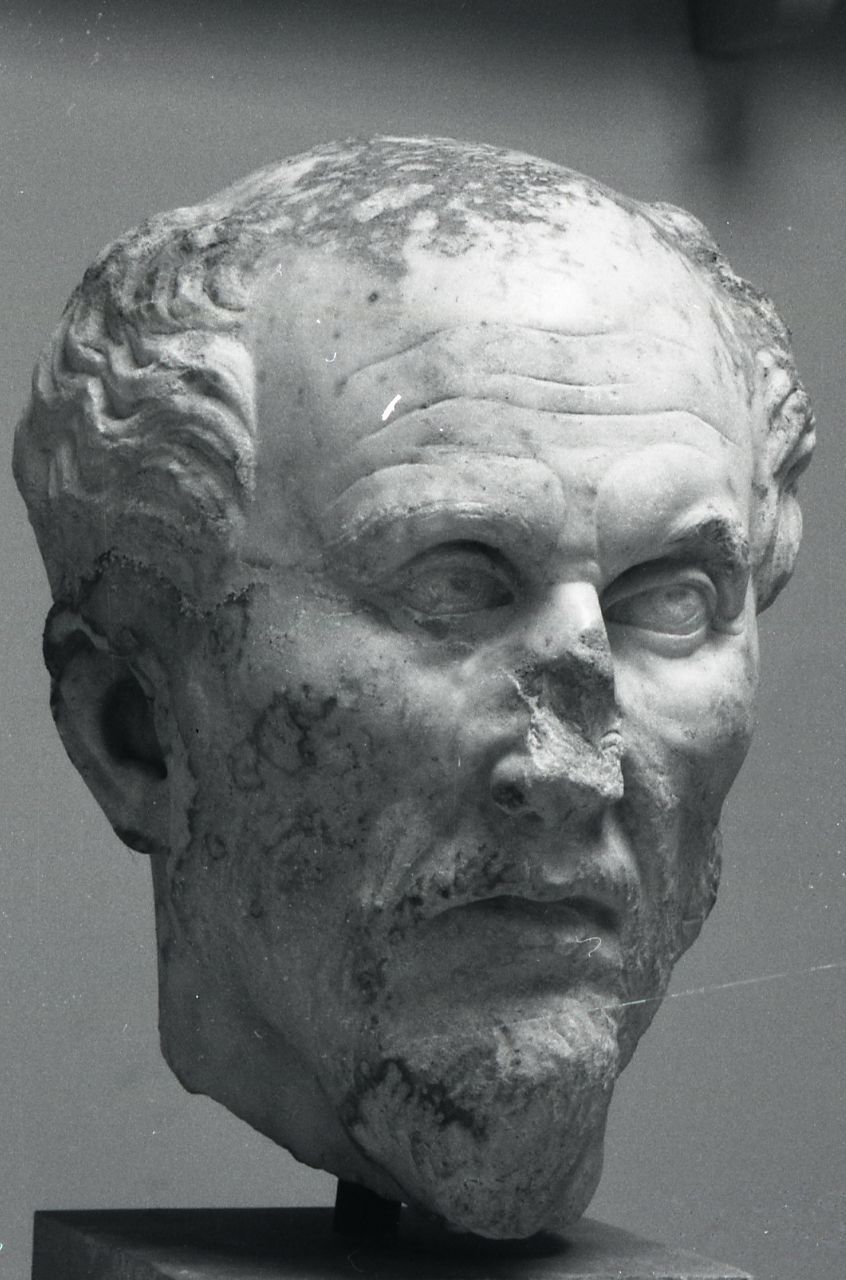
_-_BEIC_6353762.jpg)
Such is the life of the divinities; such is also that of divine and blessed men; detachment from all things here below, scorn of all earthly pleasures, and flight of the soul towards the Divinity that she shall see face to face.
Plotinus studied philosophy in Alexandria and taught in Rome from the mid-240s until shortly before his death. His writings were edited after his death by his student Porphyry, who arranged them into six groups of nine treatises, the Enneads.
Developing ideas from Plato, Plotinus described reality as a hierarchy flowing from the One, which is beyond being and beyond description, through Intellect and Soul down to the physical world. Human beings can turn inward and rise towards the One through philosophy and contemplation. His thought shaped late ancient philosophy and, through Augustine and others, Christian, Jewish and Islamic thought.
Key ideas
- The One
- The first principle of everything is the One, or the Good. A cause must be simpler than its effects, so the first principle must be utterly simple. That makes it beyond our ordinary thought, and we can speak of it only in metaphors.
- Everything flows from the One
- The One’s power is so unlimited that it can’t remain enclosed in itself. It “expresses” itself in an outflow, producing everything else in a scale of ever-declining unity.
- Intellect, Soul and the sensible world
- Below the One come Intellect, where the forms exist as active, interconnected intellects, and then Soul, which animates bodies. The world we perceive is produced and ordered by these higher principles.
- The undescended soul
- The soul is present whole in every part of the body it animates, yet it remains “undescended”, untouched by the body. Only excessive concern for its body entangles it in what the body undergoes.
- Tradition
- Western
- Region
- Alexandria and Rome
- Schools
- Neoplatonism
- Period
- Ancient Greek and Roman
- Themes
- What is ultimately real
Influences
Influenced by
Plotinusc. 204 – 270 CE
Influenced
Influenced by
Plotinusc. 204 – 270 CE
Influenced
Where these links come from
- Plotinus drew on Plato. Source: Paul Kalligas, Plotinus, Stanford Encyclopedia of Philosophy
- Plotinus drew on Aristotle. Source: Paul Kalligas, Plotinus, Stanford Encyclopedia of Philosophy
- Augustine drew on Plotinus. Source: Christian Tornau, Augustine of Hippo, Stanford Encyclopedia of Philosophy
- Proclus drew on and argued against Plotinus. Source: Christoph Helmig and Carlos Steel, Proclus, Stanford Encyclopedia of Philosophy
- al-Kindi drew on Plotinus. Source: Peter Adamson, al-Kindi, Stanford Encyclopedia of Philosophy
- Avicenna drew on Plotinus. Source: Dimitri Gutas, Ibn Sina [Avicenna], Stanford Encyclopedia of Philosophy
- Solomon ibn Gabirol drew on Plotinus. Source: Sarah Pessin, Solomon Ibn Gabirol [Avicebron], Stanford Encyclopedia of Philosophy
- Giordano Bruno drew on Plotinus. Source: Dilwyn Knox, Giordano Bruno, Stanford Encyclopedia of Philosophy
Key works
- Enneads
- Read free at Project Gutenberg (translated by Kenneth Sylvan Guthrie, volume 1 of 4)
Sources
- Paul Kalligas, Plotinus, Stanford Encyclopedia of Philosophy