Philosopher
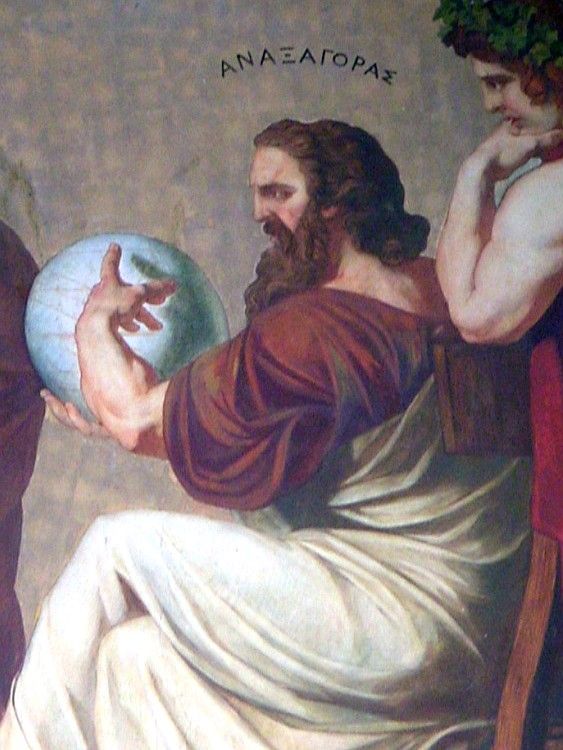
Anaxagoras
c. 500 – 428 BCE
Also known as Anaxagoras of Clazomenae
The first philosopher to live in Athens, he held that everything contains a share of everything else, and that a cosmic mind, _nous_, set the world spinning into order.

In everything there is a portion of everything except Nous, and there are some things in which there is Nous also.
Anaxagoras came from Clazomenae, on the coast of Anatolia near Miletus, and is said to have given up a landed inheritance for philosophy. He was born around 500 BCE and spent twenty or thirty years in Athens, the first philosopher known to have lived there, as a friend of the statesman Pericles. The playwrights knew his ideas, and Plato’s Socrates says his book could be bought for a drachma. His claim that the sun is a burning stone led to a charge of impiety; he left for Lampsacus, where he died in 428 and was buried with honour. The dates of his stay in Athens and of his trial are disputed.
He belongs to the Milesian tradition of explaining nature by its own regularities, without appeal to the gods, but he also took Parmenides’ arguments against coming into being seriously and built a physics that respects them. His idea of a cosmic mind shaped Plato’s account of the ordering intelligence in the Timaeus and Aristotle’s unmoved mover and theory of the intellect, although in the Phaedo Socrates complains that Anaxagoras failed to explain how mind arranges things for the best.
Key ideas
- Nothing comes to be
- Accepting Parmenides’ ban on coming into being, he held that the basic kinds of stuff are eternal. What we call birth is mixing together, and what we call death is separating out.
- A share of everything in everything
- There are indefinitely many basic kinds of stuff, and every portion of matter, however small, contains some of each; there is no smallest bit. A thing counts as gold or hair because that ingredient predominates in it.
- Nous, cosmic mind
- Mind (nous) alone is unmixed: pure, self-governing and knowing everything. It started a rotation from a small region that spreads ever wider, sorting the mixture into the sky, the heavenly bodies and the earth, and producing other worlds like ours.
- The sun is a stone
- He explained thunder, hail, rainbows and eclipses by natural causes, and said the sun, traditionally a god, is a glowing stone. He was the first Greek to give the correct account of eclipses, and his claim that heavy bodies in the sky can fall seemed borne out when a meteorite came down at Aegospotami.
- Tradition
- Western
- Region
- Clazomenae, Ionia; Athens; Lampsacus
- Period
- Ancient Greek and Roman
- Themes
- What is ultimately real
Influences
Influenced by
Anaxagorasc. 500 – 428 BCE
Influenced
Influenced by
Anaxagorasc. 500 – 428 BCE
Influenced
Where these links come from
- Anaxagoras drew on Parmenides. Source: John Sisko and Patricia Curd, Anaxagoras, Stanford Encyclopedia of Philosophy
- Plato drew on and argued against Anaxagoras. Source: John Sisko and Patricia Curd, Anaxagoras, Stanford Encyclopedia of Philosophy
- Aristotle drew on Anaxagoras. Source: John Sisko and Patricia Curd, Anaxagoras, Stanford Encyclopedia of Philosophy
Key works
- On Nature
Sources
- John Sisko and Patricia Curd, Anaxagoras, Stanford Encyclopedia of Philosophy