Philosopher
William of Ockham
c. 1287 – 1347
Also known as Occam
Franciscan logician and nominalist, remembered for "Ockham's Razor", the principle that we should not assume more entities than we need.
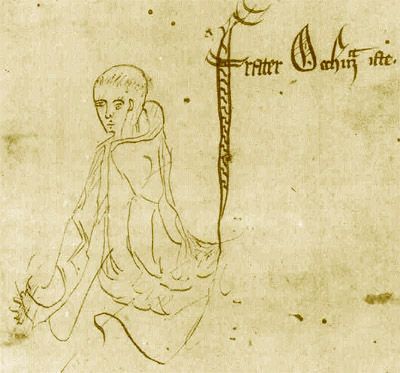

William of Ockham was an English Franciscan who studied and taught at Oxford. Summoned to the papal court at Avignon to answer charges about his teaching, he became caught up in a dispute with Pope John XXII over the poverty of Christ and the apostles, fled in 1328, and spent the rest of his life under the protection of the Emperor Louis IV, mostly in Munich.
He is the leading nominalist of the Middle Ages: he held that only individual things exist, and that universals such as “humanity” are names or concepts that apply to many individuals. The principle of economy that bears his name, not to multiply entities beyond necessity, sums up his approach, though he never used that exact phrase.
Key ideas
- Ockham’s razor
- We shouldn’t accept a claim that requires more kinds of thing to exist than a rival claim does, unless reason, experience or Scripture gives us grounds. The famous slogan “do not multiply entities beyond necessity” isn’t in his texts, but the sentiment is his.
- No universal things
- There is no universal “felinity”, only individual cats that resemble one another. The only universals are concepts and words, which are “universal” only because they apply to many things.
- Only substances and qualities
- Of Aristotle’s ten categories, Ockham thought only two name real kinds of being, substance and quality. The others are kinds of term, not kinds of thing.
- Mental language
- Ockham was the first to work out in detail the idea of a language of thought. Spoken words vary by convention (“dog”, “chien”), but the concepts they express signify things by nature and combine into mental sentences.
- God’s commands
- Ockham’s ethics includes a strong dose of divine command theory. Certain acts are required, allowed or prohibited for no other reason than that God commands it.
- Tradition
- Western
- Region
- England and Munich
- Schools
- Scholasticism
- Period
- Medieval
Influences
Influenced by
William of Ockhamc. 1287 – 1347
Influenced by
William of Ockhamc. 1287 – 1347
Where these links come from
- William of Ockham drew on Aristotle. Source: Paul Vincent Spade, Claude Panaccio and Jenny Pelletier, William of Ockham, Stanford Encyclopedia of Philosophy
- William of Ockham argued against John Duns Scotus. Source: Paul Vincent Spade, Claude Panaccio and Jenny Pelletier, William of Ockham, Stanford Encyclopedia of Philosophy
Key works
- Summa of Logic (Summa Logicae), c. 1323
Often attributed, but not said
Entities must not be multiplied beyond necessity.
A later slogan for “Ockham’s Razor”: the principle is his, but this wording is nowhere to be found in his texts. Source: William of Ockham, Stanford Encyclopedia of Philosophy
Sources
- Paul Vincent Spade, Claude Panaccio and Jenny Pelletier, William of Ockham, Stanford Encyclopedia of Philosophy