Philosopher
Desiderius Erasmus
1469–1536
Also known as Erasmus, Erasmus of Rotterdam
Humanist scholar who edited the Greek New Testament, satirised scholastic theology in _The Praise of Folly_, and defended free will against Luther with a sceptic's reluctance to assert.
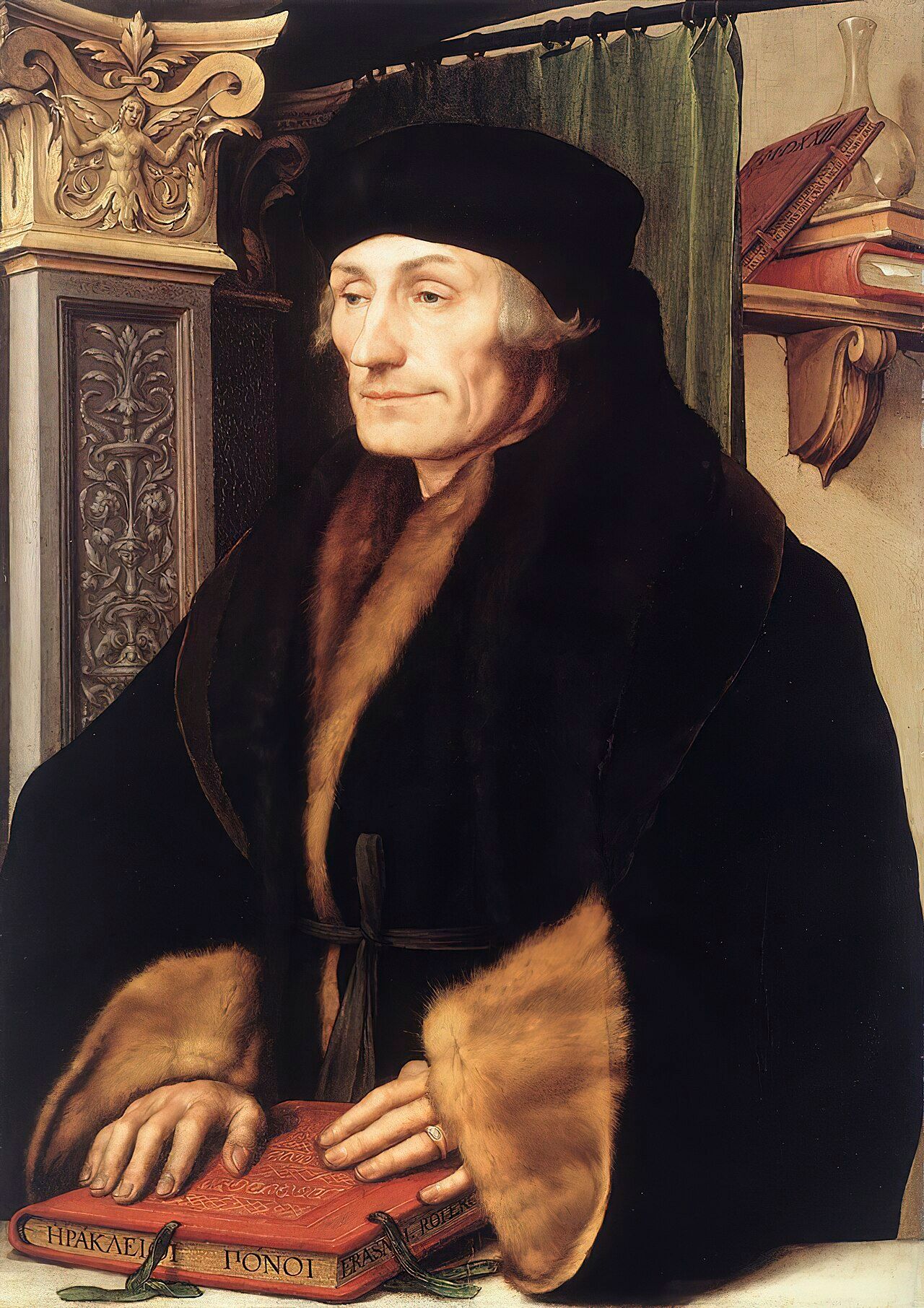

I take so little pleasure in assertions that I will gladly seek refuge in Scepticism.
Erasmus was born in Rotterdam in 1469, the illegitimate son of a priest. Orphaned young, he was steered by his guardians into a monastery of Augustinian canons and ordained in 1492, a choice he later said was forced on him. He went to Paris to study theology in 1495 but disliked scholasticism and supported himself by tutoring. A visit to England in 1499 brought lifelong friends, among them Thomas More and John Colet, and turned him towards Greek and the Bible. After years of travel he settled in Leuven in 1517 and in Basel in 1521, moving to Catholic Freiburg when Basel became Protestant in 1529. He died in 1536.
He was not a systematic philosopher, but his books, from The Praise of Folly (1511) to the Adages and Colloquies, were read across Europe, and he shaped opinion as few writers have. His “Christian humanism” joined classical learning to Christian piety. Contemporaries saw him as a forerunner of the Reformation, but he broke with Luther, and after his death the Catholic Church placed his works on the Index of Prohibited Books. The Enlightenment later revived him as a forerunner of rationalism.
Key ideas
- The philosophy of Christ
- True piety is an inner quality of mind, open to everyone and shown in how one lives, not in outward ceremonies performed without sincere faith. Its model is the simple teaching of the gospel, which he preferred to the subtleties of scholastic theology.
- Back to the sources
- Scripture should be read in its original languages and corrected by careful study of the manuscripts. His Greek New Testament of 1516, the first to be published, applied the humanists’ philological methods to the Bible.
- Education makes us human
- Humans are rational beings, and ignorance does them most harm. Because the will is free, nurture counts for more than nature, and good teaching can raise people above the level of beasts.
- Scepticism and free will
- Against Luther, he set out the scriptural evidence for and against free will and found it inconclusive. His own leaning was to suspend judgement, but on matters Scripture leaves unclear he deferred to the Church’s consensus, which affirmed free will.
- Peace and compromise
- War is unchristian, fit for beasts, and at best a last resort. Disputes between rulers, and even the religious conflict of his day, should be settled by arbitration, councils and mutual concessions.
- Tradition
- Western
- Region
- Rotterdam; Leuven; Basel; Freiburg
Influences
Where these links come from
- Desiderius Erasmus drew on Plato. Source: Erika Rummel and Eric MacPhail, Desiderius Erasmus, Stanford Encyclopedia of Philosophy
- Desiderius Erasmus drew on Cicero. Source: Erika Rummel and Eric MacPhail, Desiderius Erasmus, Stanford Encyclopedia of Philosophy
Key works
- The Praise of Folly (Moriae encomium)
- Read free at Project Gutenberg (translated by John Wilson)
- A Discussion of Free Will (De libero arbitrio)
- Handbook of the Christian Soldier (Enchiridion militis Christiani)
- The Education of a Christian Prince (Institutio principis Christiani)
- Colloquies (Colloquia)
- Read free at Project Gutenberg (translated by N. Bailey, volume 1)
Sources
- Erika Rummel and Eric MacPhail, Desiderius Erasmus, Stanford Encyclopedia of Philosophy