Philosopher
Augustine
354–430 CE
Also known as Augustine of Hippo, Aurelius Augustinus
Bishop of Hippo whose writings on sin, grace, free will and time made him the most influential Christian thinker of late antiquity and the Latin Middle Ages.
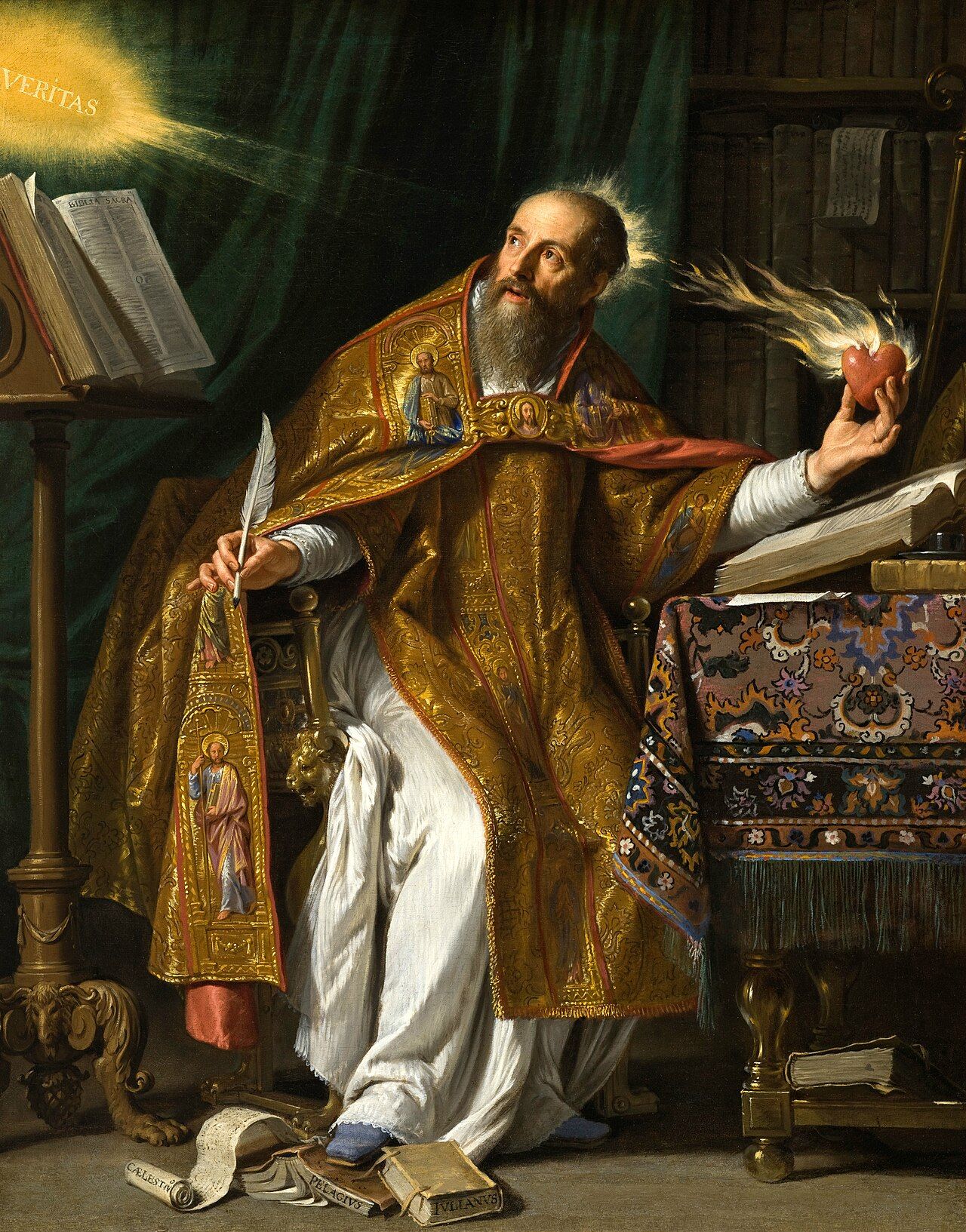

Thou madest us for Thyself, and our heart is restless, until it repose in Thee.
Born in Thagaste in Roman North Africa, Augustine taught rhetoric in Carthage, Rome and Milan before converting to Christianity in 386; he later became bishop of Hippo. His Confessions tells the story of his restless search for truth, and includes a famous reflection on the nature of time.
Reading Platonist philosophers, above all Plotinus, helped him think of God and the soul as immaterial. He wrote extensively on free will, evil, grace and the relation between faith and reason, and in The City of God he contrasted the “earthly city” with the “city of God”. His authority in the Latin West went almost unchallenged for a thousand years.
Key ideas
- “If I am mistaken, I exist”
- Against the sceptics, Augustine argued that being mistaken proves I exist, since there must be someone who is mistaken. The argument is similar to, and probably inspired, Descartes’s cogito.
- Evil as privation
- Evil is not a substance but a lack or corruption of goodness. Everything that exists is good in its degree, because God created it; moral evil is an evil will.
- The will
- No earlier philosopher came as close as Augustine to seeing the will as a power of choosing, distinct from both reason and desire. Some scholars say he “discovered” the will.
- Time and the mind
- Past, present and future don’t truly exist: the past is gone, the future not yet, and the present has no length. Time is real for us as present memory of the past, attention to the present and expectation of the future.
- Tradition
- Western
- Region
- North Africa and Italy
- Period
- Ancient Greek and Roman
Influences
Influenced by
Augustine354–430 CE
Influenced
500 CE – 1400
- John Scottus Eriugenac. 800 – c. 877 CE
- Anselm of Canterbury1033–1109
- Peter Abelardc. 1079 – 1142
- Bonaventurec. 1221 – 1274
- Thomas Aquinasc. 1225 – 1274
- Meister Eckhartc. 1260 – c. 1328
1400 – 1800
1800 – 1900
1900 onwards
Influenced by
Augustine354–430 CE
Influenced
500 CE – 1400
- John Scottus Eriugenac. 800 – c. 877 CE
- Anselm of Canterbury1033–1109
- Peter Abelardc. 1079 – 1142
- Bonaventurec. 1221 – 1274
- Thomas Aquinasc. 1225 – 1274
- Meister Eckhartc. 1260 – c. 1328
1400 – 1800
1800 – 1900
1900 onwards
Where these links come from
- Augustine drew on Plato. Source: Christian Tornau, Augustine of Hippo, Stanford Encyclopedia of Philosophy
- Augustine drew on Plotinus. Source: Christian Tornau, Augustine of Hippo, Stanford Encyclopedia of Philosophy
- John Scottus Eriugena drew on Augustine. Source: Dermot Moran and Adrian Guiu, John Scottus Eriugena, Stanford Encyclopedia of Philosophy
- Anselm of Canterbury drew on Augustine. Source: Thomas Williams, Anselm of Canterbury, Stanford Encyclopedia of Philosophy
- Peter Abelard drew on Augustine. Source: Christian Tornau, Augustine of Hippo, Stanford Encyclopedia of Philosophy
- Bonaventure drew on Augustine. Source: Tim Noone, R. E. Houser and Joshua Benson, Bonaventure, Stanford Encyclopedia of Philosophy
- Thomas Aquinas drew on Augustine. Source: Robert Pasnau, Thomas Aquinas, Stanford Encyclopedia of Philosophy
- Meister Eckhart drew on Augustine. Source: Amber L. Griffioen, Meister Eckhart, Stanford Encyclopedia of Philosophy
- Blaise Pascal drew on Augustine. Source: Desmond Clarke and William Wood, Blaise Pascal, Stanford Encyclopedia of Philosophy
- Nicolas Malebranche drew on Augustine. Source: Tad Schmaltz, Nicolas Malebranche, Stanford Encyclopedia of Philosophy
- Ludwig Wittgenstein argued against Augustine. Source: Anat Biletzki and Anat Matar, Ludwig Wittgenstein, Stanford Encyclopedia of Philosophy
- Hannah Arendt drew on Augustine. Source: Tatjana Tömmel and Maurizio Passerin d’Entrèves, Hannah Arendt, Stanford Encyclopedia of Philosophy
Key works
- Confessions (Confessiones), c. 400 CE
- Read free at Project Gutenberg (translated by E. B. Pusey)
- The City of God (De civitate Dei), 426 CE
- Read free at Standard Ebooks (translated by Marcus Dods, George Wilson and J. J. Smith)
Sources
- Christian Tornau, Augustine of Hippo, Stanford Encyclopedia of Philosophy