Philosopher
Simone Weil
1909–1943
French philosopher, activist and mystic who worked in factories to understand oppression, and whose late thought centred on attention, affliction and the soul's need for roots.
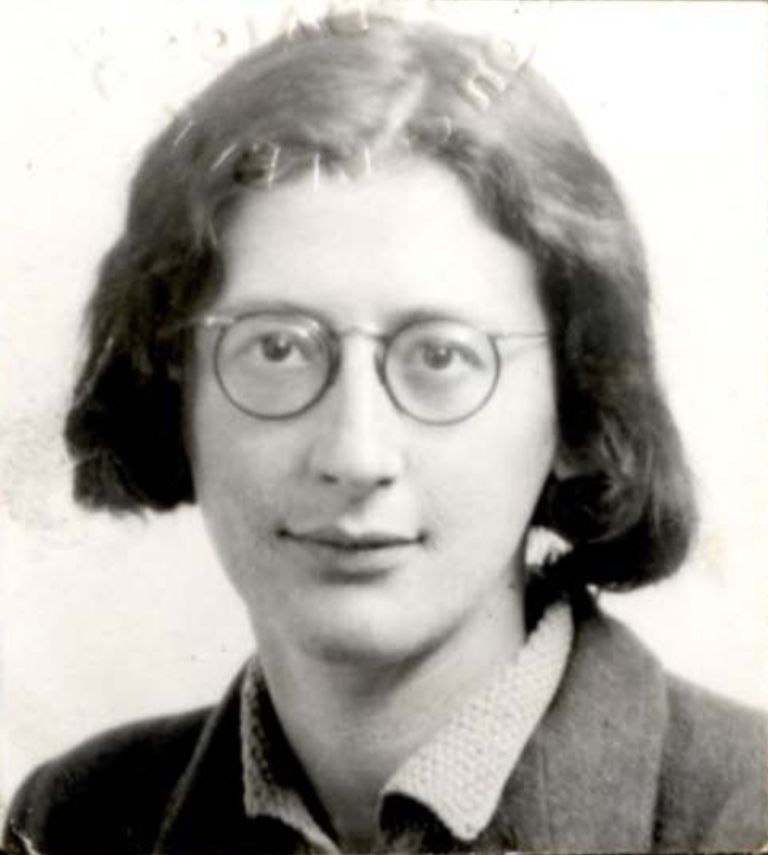

Philosophy (including problems of cognition, etc.) is exclusively an affair of action and practice.
Weil was born in Paris in 1909 to a secular family of Jewish origin; her brother André became a distinguished mathematician. She studied under the philosopher Alain and in 1928 entered the École Normale Supérieure, the only woman in her class. While teaching in provincial lycées she taught and campaigned for workers’ groups, and in 1934–35 she spent months as an unskilled factory worker in Paris.
She joined an anarchist brigade in the Spanish Civil War until a burn forced her home, and experiences in Portugal, Italy and the abbey of Solesmes drew her to Christianity. In 1942 she left France for New York and then London, where she worked for the Free French, writing some 800 pages in four months. Having insisted on eating no more than the rations of her compatriots in occupied France, she died in England in August 1943 and was buried at Ashford. None of her writings appeared as a book in her lifetime; Albert Camus was among those who published them after her death.
Key ideas
- Oppression and labour
- Using a Marxian method, Weil analysed the causes of oppression while rejecting any belief that revolution was inevitable. Her months in Paris factories showed her that modern industrial work produces humiliation, fatigue and docility rather than rebellion.
- Attention
- Weil’s central ethical concept is attention, an orientation rather than a rule, learned through long apprenticeship. It discerns what another person is suffering and the conditions that cause it, and works by a “negative effort” of releasing one’s own projects and desires.
- Obligations before rights
- Rights rely on force. Weil set against them obligations, justice and, in The Need for Roots, the “needs of the soul”, a morality grounded in compassion and oriented towards a supernatural justice.
- Rootedness
- Weil’s late political thought pictures society as a living thing with roots, vital but vulnerable, which needs stability and security if individuals are to grow and flourish. Roots link society as it actually is to the ideal of a supernatural justice.
- Decreation
- God, purely good, withdrew so that a finite, imperfect world could exist. Imitating God, human beings should renounce their imagined centrality and power out of love, a “passive activity” Weil called decreation.
- Tradition
- Western
- Region
- France
- Period
- Contemporary
Influences
Influenced by
- Platoc. 429 – 347 BCE
- René Descartes1596–1650
- Immanuel Kant1724–1804criticised
- Karl Marx1818–1883criticised
Simone Weil1909–1943
Influenced
Influenced by
- Platoc. 429 – 347 BCE
- René Descartes1596–1650
- Immanuel Kant1724–1804criticised
- Karl Marx1818–1883criticised
Simone Weil1909–1943
Influenced
Where these links come from
- Simone Weil drew on Plato. Source: A. Rebecca Rozelle-Stone and Benjamin P. Davis, Simone Weil, Stanford Encyclopedia of Philosophy
- Simone Weil drew on René Descartes. Source: A. Rebecca Rozelle-Stone and Benjamin P. Davis, Simone Weil, Stanford Encyclopedia of Philosophy
- Simone Weil drew on and argued against Immanuel Kant. Source: A. Rebecca Rozelle-Stone and Benjamin P. Davis, Simone Weil, Stanford Encyclopedia of Philosophy
- Simone Weil drew on and argued against Karl Marx. Source: A. Rebecca Rozelle-Stone and Benjamin P. Davis, Simone Weil, Stanford Encyclopedia of Philosophy
- Iris Murdoch drew on Simone Weil. Source: Lawrence Blum, Iris Murdoch, Stanford Encyclopedia of Philosophy
Key works
- Reflections Concerning the Causes of Liberty and Social Oppression, 1934
- Waiting for God (Attente de Dieu)
- Gravity and Grace (La Pesanteur et la grâce)
- The Need for Roots (L'Enracinement)
Sources
- A. Rebecca Rozelle-Stone and Benjamin P. Davis, Simone Weil, Stanford Encyclopedia of Philosophy