Philosopher
Niccolò Machiavelli
1469–1527
Also known as Niccolo Machiavelli, Machiavelli
Florentine diplomat and political thinker whose Prince analysed power without moralising, and whose Discourses on Livy championed republican liberty.
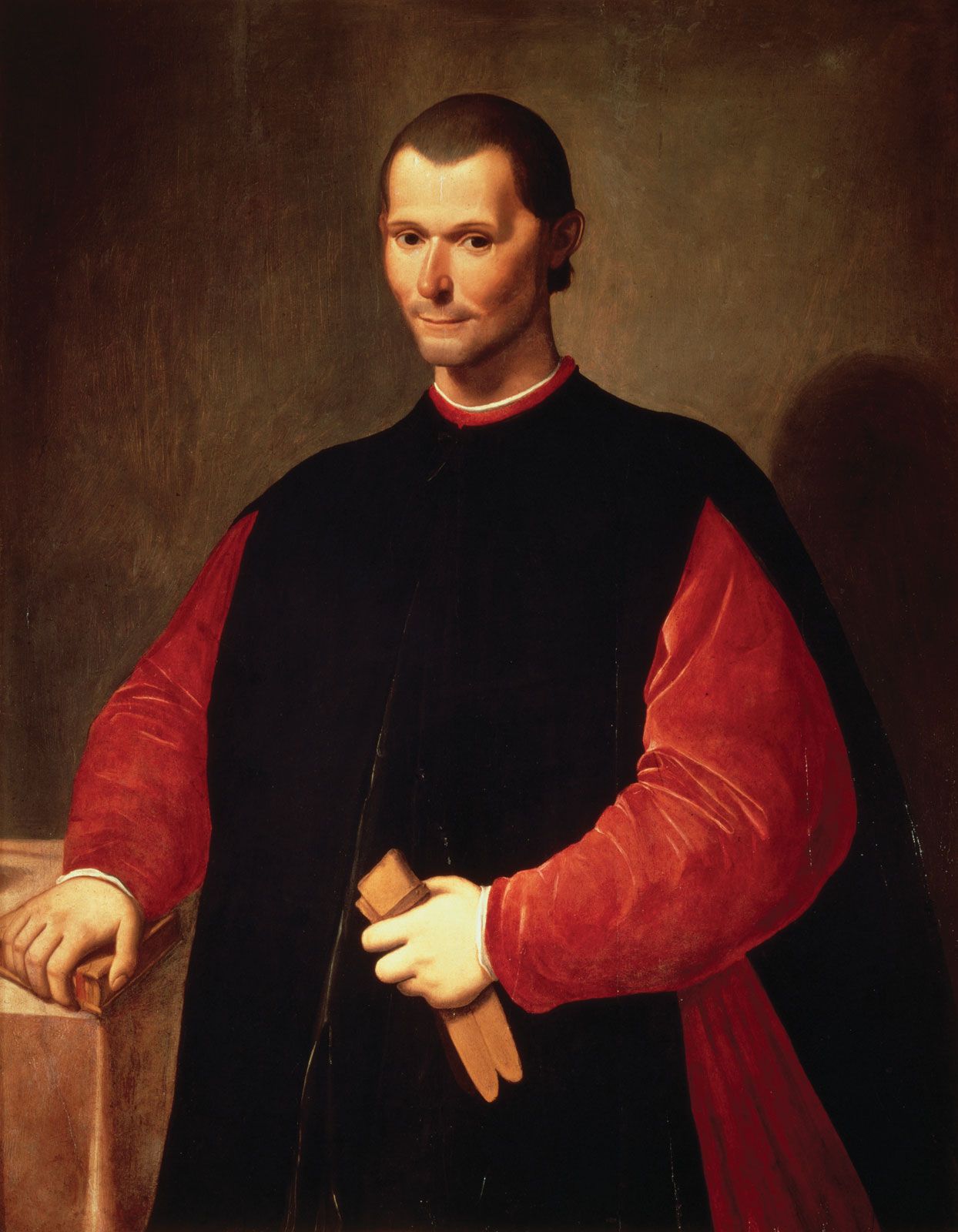

It may be answered that one should wish to be both, but, because it is difficult to unite them in one person, it is much safer to be feared than loved, when, of the two, either must be dispensed with.
Machiavelli was born in Florence on 3 May 1469 and received an excellent humanist education. In 1498 he became Second Chancellor of the Florentine Republic and for fourteen years travelled on diplomatic missions to the courts of Italy, France and the Emperor. When the Medici overthrew the republic in 1512 he lost his post. Out of office, he wrote The Prince and the Discourses on Livy, and later the Florentine Histories, commissioned by the Medici themselves. He died on 21 June 1527.
Machiavelli never considered himself a philosopher and his writings are notoriously unsystematic, but later political philosophers of the first rank have felt compelled to answer him. Some condemned him as the Devil’s disciple, while theorists of “reason of state” read him with sympathy, and today’s “neo-Roman” republicans draw on his idea of liberty. He has been credited, though disputedly, with the first modern concept of the state.
Key ideas
- Politics without moralising
- Earlier writers held that moral goodness makes a ruler legitimate. Machiavelli looked instead at how power is actually gained and kept, and rejected utopian schemes such as Plato’s as beside the point.
- Virtù and fortune
- A ruler’s virtù is not moral virtue but the set of qualities needed to keep the state and achieve great things, above all a flexible disposition, able to move from good to evil and back as circumstances demand. Fortune is the ever-present threat to political order.
- Better feared than loved
- A ruler would ideally be both loved and feared, but if one must be given up, it is safer to be feared. Whether Machiavelli was a “teacher of evil” or a realist setting ordinary ethics aside in politics is still debated.
- Republics and the people
- In the Discourses Machiavelli praises republican liberty and trusts the people: they care more for liberty than princes or nobles do, and a people is “more prudent, more stable, and of better judgment than a prince”.
- Tradition
- Western
- Region
- Florence
- Themes
- How to govern
Influences
Where these links come from
- Niccolò Machiavelli argued against Plato. Source: Cary Nederman, Niccolò Machiavelli, Stanford Encyclopedia of Philosophy
Key works
- The Prince (Il Principe)
- Read free at Project Gutenberg (translated by W. K. Marriott)
- Discourses on Livy (Discorsi sopra la prima deca di Tito Livio)
- Read free at Project Gutenberg (translated by Ninian Hill Thomson, as Discourses on the First Decade of Titus Livius)
- Florentine Histories (Istorie fiorentine)
Sources
- Cary Nederman, Niccolò Machiavelli, Stanford Encyclopedia of Philosophy