Philosopher
Blaise Pascal
1623–1662
Also known as Pascal
French mathematician and scientist whose unfinished Pensées, a defence of Christianity, reflect on human wretchedness and greatness, the thinking reed.
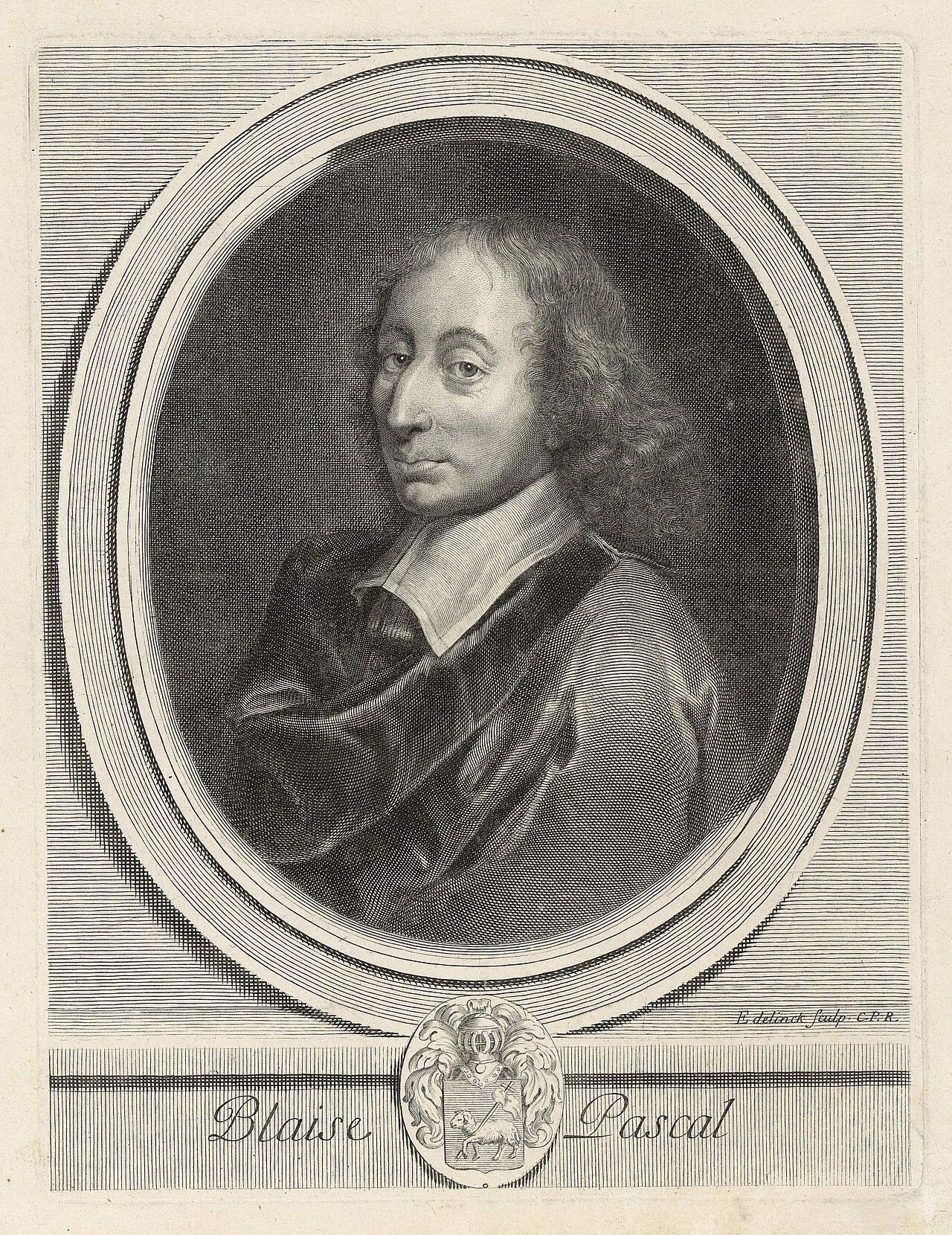
.jpg)
Man is but a reed, weakest in nature, but a reed which thinks.
Pascal was born in Clermont on 19 June 1623 and educated at home by his father, a mathematician; he was never trained in scholastic philosophy or theology. Ill for most of his life, he was nonetheless a precocious scientist: he built one of the first calculating machines, experimented with the vacuum and barometers, and was drawn into the circle of Mersenne as a young mathematician. He died in Paris in 1662, aged thirty-nine.
In the Provincial Letters he defended the Jansenist Antoine Arnauld and attacked the lax morality of the Jesuits. He never published a work of philosophy; his notes for a planned defence of Christianity appeared after his death as the Pensées. He admired Montaigne as a critic of dogmatism, and Epictetus as a moralist, though he thought it arrogance to believe, as Epictetus did, that we can perfect ourselves by our own efforts. His reflections on the contingency and fragility of human life have struck a chord with later existentialist writers.
Key ideas
- The thinking reed
- A human being is frail, a reed that a drop of water could kill, and tiny beside an infinite universe. Yet our dignity lies in thought: space engulfs us like a point, but by thought we comprehend the universe.
- Three kinds of judge
- The eyes judge matters of fact, reason judges natural and intelligible things, and faith judges what is supernatural and revealed. On questions of fact, authority is useless, even the Pope’s.
- Corrupted reason
- Human nature was corrupted by the Fall, so reason is an unreliable moral guide. “There are undoubtedly natural laws, but our fine corrupted reason has corrupted everything.” Morality rests on what remains of God’s law.
- Grace and choice
- Following Augustine and the Jansenists, Pascal held that ordinary choices follow our dominant desires. Choosing to act morally becomes possible only when God’s grace intervenes.
- Tradition
- Western
- Region
- Clermont, Rouen and Paris, France
- Period
- Early modern
Influences
Influenced by
Blaise Pascal1623–1662
Influenced by
Blaise Pascal1623–1662
Where these links come from
- Blaise Pascal drew on and argued against Epictetus. Source: Margaret Graver, Epictetus, Stanford Encyclopedia of Philosophy
- Blaise Pascal drew on Augustine. Source: Desmond Clarke and William Wood, Blaise Pascal, Stanford Encyclopedia of Philosophy
- Blaise Pascal drew on Michel de Montaigne. Source: Desmond Clarke and William Wood, Blaise Pascal, Stanford Encyclopedia of Philosophy
Key works
- Pensées, 1670
- Read free at Project Gutenberg (translated by C. Kegan Paul, as The Thoughts of Blaise Pascal)
- Provincial Letters (Lettres provinciales)
- Read free at Project Gutenberg (translated by Thomas M'Crie)
Sources
- Desmond Clarke and William Wood, Blaise Pascal, Stanford Encyclopedia of Philosophy
- Margaret Graver, Epictetus, Stanford Encyclopedia of Philosophy