Philosopher
John Scottus Eriugena
c. 800 – c. 877 CE
Also known as Johannes Scottus Eriugena, John Scotus Erigena, Eriugena
Irish scholar at the Frankish court who knew Greek, translated the Greek Christian Neoplatonists and wove them into a vast system in which all of nature flows out of God and returns.
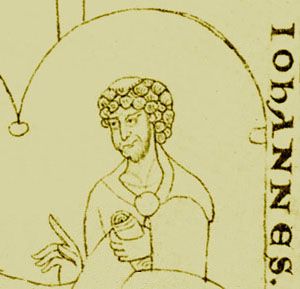

No one enters heaven except through philosophy.
For God did not create in man a captive will but a free one, and that freedom remained after sin.
Eriugena was born in Ireland around 800; he signed himself “Eriugena”, “Irish-born”, and his contemporaries called him “the Irishman”. By about 850 he was a master of the liberal arts at the court of the West Frankish king Charles the Bald, and he was known for his learning and his skill in dialectic. Bishops commissioned him to refute Gottschalk’s teaching that God predestines some to heaven and others to hell, His reply, On Divine Predestination, argued that God wills everyone to be saved and that people damn themselves by their own free choices. Bishop Prudentius of Troyes accused him in turn of heresy and dismissed his reasoning as unscriptural.
Unusually for a western scholar of his time he knew Greek, and he translated the works of Pseudo-Dionysius the Areopagite, a Christian follower of Proclus, as well as Gregory of Nyssa and Maximus Confessor. From these Greek fathers, and from Augustine and Boethius, he built the Periphyseon, a long dialogue finished around 867. It found few readers in his own century, was revived in the twelfth, and was condemned in the thirteenth for identifying God with creation. It still influenced Meister Eckhart and, above all, Nicholas of Cusa, and nineteenth-century idealists hailed him as a forerunner.
Key ideas
- The four divisions of nature
- “Nature” covers everything that is and is not, God and creation alike. It divides into what creates and is not created (God), what creates and is created (the primary causes), what is created and does not create (created things), and what neither creates nor is created (God as the end of all).
- Going out and return
- God unfolds himself into the primary causes, the ideas in the divine Word, and these proceed into their effects, the created world. Everything depends on its causes and will finally return to them, and through them to God.
- God as nothing
- God so exceeds everything we can sense or think that he is best said not to be; he is “nothing through excellence”. Saying that one level of reality is means denying that the level above it is in the same way.
- Philosophy and religion are one
- True philosophy is true religion, and true religion is true philosophy. Theological questions are to be settled by reasoned argument, by division, definition, demonstration and analysis, and not merely by quoting authorities.
- Tradition
- Western
- Region
- Ireland; the court of Charles the Bald, West Francia
- Schools
- Neoplatonism
- Period
- Medieval
Influences
Influenced by
John Scottus Eriugenac. 800 – c. 877 CE
Influenced
Influenced by
John Scottus Eriugenac. 800 – c. 877 CE
Influenced
Where these links come from
- John Scottus Eriugena drew on Augustine. Source: Dermot Moran and Adrian Guiu, John Scottus Eriugena, Stanford Encyclopedia of Philosophy
- John Scottus Eriugena drew on Boethius. Source: Dermot Moran and Adrian Guiu, John Scottus Eriugena, Stanford Encyclopedia of Philosophy
- Meister Eckhart drew on John Scottus Eriugena. Source: Dermot Moran and Adrian Guiu, John Scottus Eriugena, Stanford Encyclopedia of Philosophy
- Nicholas of Cusa drew on John Scottus Eriugena. Source: Dermot Moran and Adrian Guiu, John Scottus Eriugena, Stanford Encyclopedia of Philosophy
Key works
- Periphyseon (De divisione naturae)
- On Divine Predestination (De divina praedestinatione)
Sources
- Dermot Moran and Adrian Guiu, John Scottus Eriugena, Stanford Encyclopedia of Philosophy