Philosopher
Hannah Arendt
1906–1975
German-American political thinker who analysed totalitarianism, defended political action and plurality, and coined the phrase "the banality of evil".
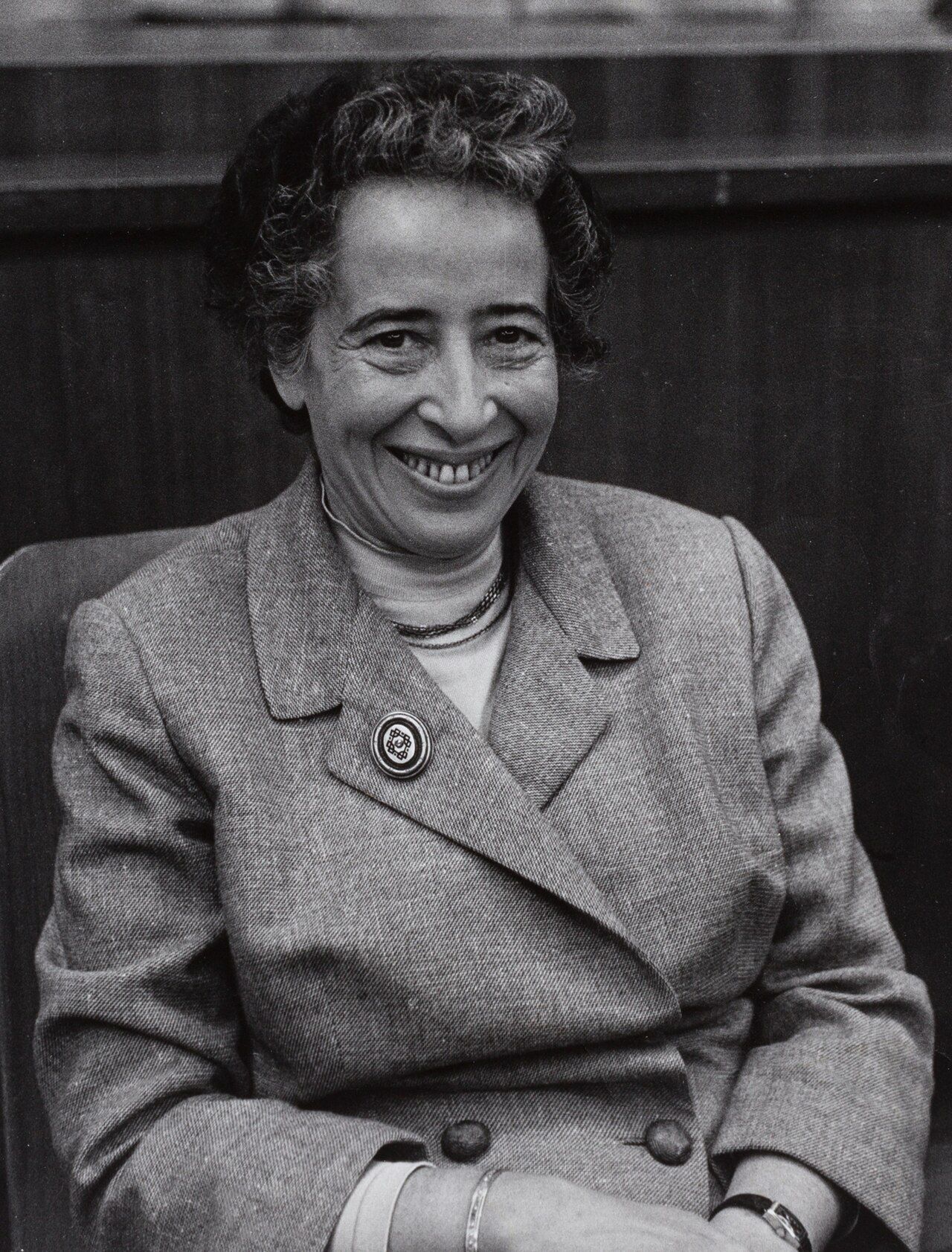
.jpg)
The fact that man is capable of action means that the unexpected can be expected from him, that he is able to perform what is infinitely improbable.
Hannah Arendt was born into a German-Jewish family in Hannover in 1906. She studied with Martin Heidegger at Marburg, with whom she had a brief affair that left a lasting mark on her thought, attended Husserl’s lectures in Freiburg, and wrote her doctorate on Augustine’s concept of love under Karl Jaspers at Heidelberg. Forced to flee Germany in 1933, she worked for Jewish refugee organisations in Paris, and in 1941 emigrated to New York.
Her Origins of Totalitarianism (1951) established her reputation, and The Human Condition (1958) set out her philosophy of action. Her report on the Eichmann trial provoked fierce controversy. She held posts at several American universities and died in 1975, leaving her last work, The Life of the Mind, on thinking, willing and judging, unfinished.
Key ideas
- Totalitarianism
- In The Origins of Totalitarianism Arendt studied Nazism and Stalinism as new forms of rule, whose radical evil lay in destroying human plurality and spontaneity and making people superfluous.
- Labour, work and action
- The active life has three activities. Labour sustains biological life, work builds a lasting world of things, and action, speaking and acting together among others, discloses who we are and realises our freedom.
- Natality and freedom
- Freedom is not choosing between options but the capacity to begin something new. It is rooted in natality: every birth brings someone unprecedented into the world, so we are capable of the unexpected.
- The banality of evil
- Reporting on the trial of Adolf Eichmann, Arendt traced his monstrous deeds not to fanatical hatred but to thoughtlessness, an inability to see anything from another’s point of view. She came to ask whether evil can be done without base motives, or any motives at all.
- Tradition
- Western
- Region
- Germany, Paris and New York
- Period
- Contemporary
- Themes
- How to govern
Influences
Influenced by
Hannah Arendt1906–1975
Influenced by
Hannah Arendt1906–1975
Where these links come from
- Hannah Arendt drew on Augustine. Source: Tatjana Tömmel and Maurizio Passerin d’Entrèves, Hannah Arendt, Stanford Encyclopedia of Philosophy
- Hannah Arendt drew on Immanuel Kant. Source: Tatjana Tömmel and Maurizio Passerin d’Entrèves, Hannah Arendt, Stanford Encyclopedia of Philosophy
- Hannah Arendt studied with and drew on Martin Heidegger. Source: Tatjana Tömmel and Maurizio Passerin d’Entrèves, Hannah Arendt, Stanford Encyclopedia of Philosophy
Key works
- The Origins of Totalitarianism, 1951
- The Human Condition, 1958
- Eichmann in Jerusalem, 1963
- The Life of the Mind
Sources
- Tatjana Tömmel and Maurizio Passerin d’Entrèves, Hannah Arendt, Stanford Encyclopedia of Philosophy