Philosopher
Baruch Spinoza
1632–1677
Also known as Benedictus de Spinoza, Bento de Espinosa
Rationalist who identified God with Nature and set out his ethics in the form of geometrical proofs.
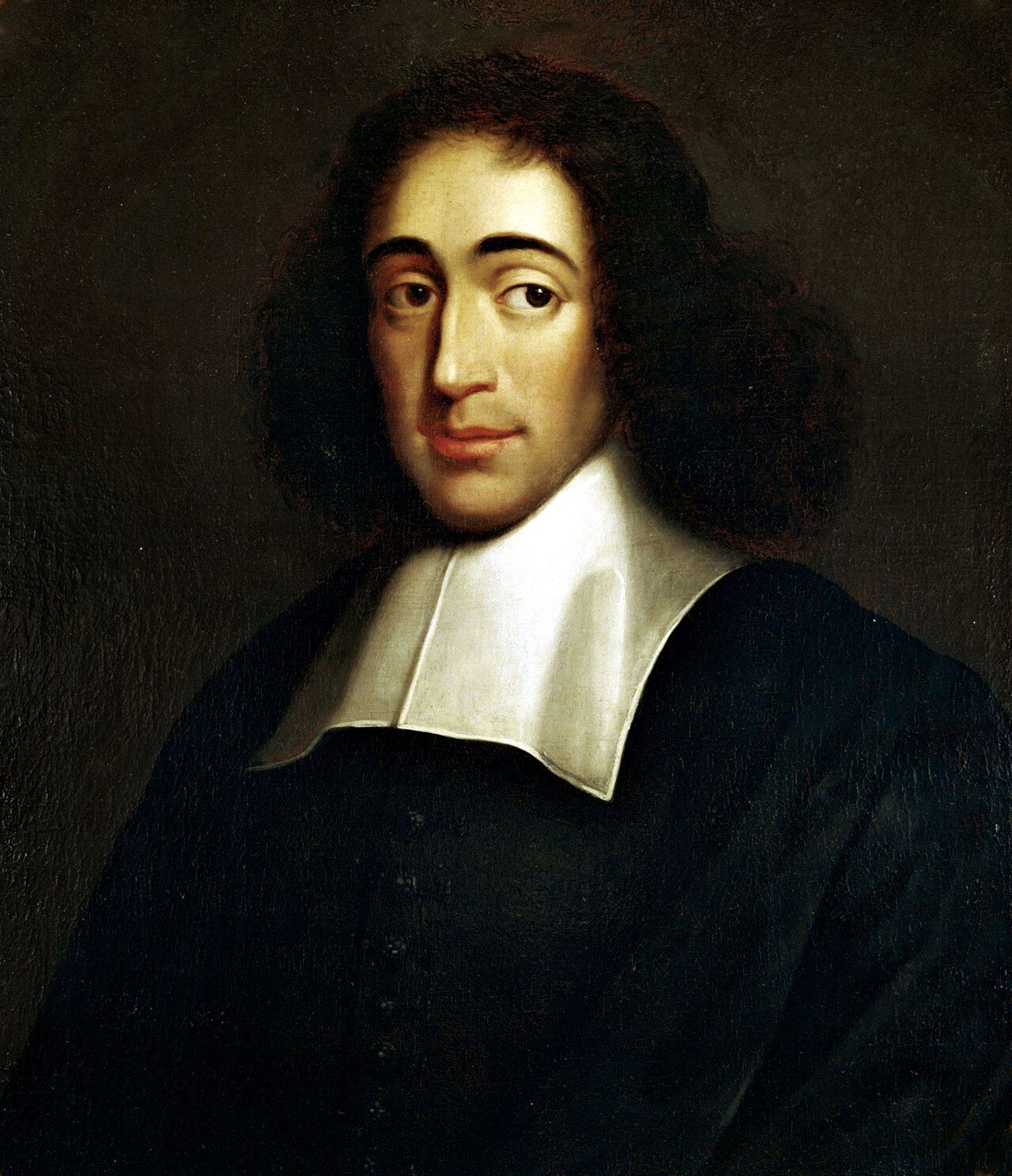

All things excellent are as difficult as they are rare.
Born into Amsterdam’s Portuguese-Jewish community and expelled from it in 1656, Spinoza argued that there is only one substance, which can be called either God or Nature. Everything, including the human mind, is a part of it and follows from its nature by necessity. His Ethics presents this system in the manner of Euclid’s geometry, and argues that freedom and happiness come from understanding that necessity.
His defence of freedom of thought and his critical reading of scripture made him one of the most controversial thinkers of his age.
Key ideas
- God, or Nature
- Reality contains just one substance, which is infinite and the cause of itself. It is God, and everything else that exists is in God. Spinoza summed this up as “God, or Nature” (Deus, sive Natura).
- Thought and extension
- Thought and extension are two attributes of the one substance. Bodies express extension and ideas express thought, and because the two have nothing in common, the physical and the mental are each causally closed.
- No free will
- Human beings are part of nature, caught up in the same chains of cause and effect as everything else. “In the Mind there is no absolute, or free, will”; our choices are as necessarily determined as any natural event.
- Freedom through understanding
- We can’t escape the passions entirely, but we can moderate them by understanding. Our virtue lies in pursuing knowledge, and the best kind is an intuitive grasp of the essences of things.
- Religion and the free state
- In the Theological-Political Treatise, Spinoza attacked superstition fostered by the clergy and argued that freedom of thought and religion is not only compatible with a well-ordered state but essential to it.
- Tradition
- Western
- Region
- Dutch Republic
- Schools
- Rationalism
- Period
- Early modern
Influences
Influenced by
Baruch Spinoza1632–1677
Influenced
Influenced by
Baruch Spinoza1632–1677
Influenced
Where these links come from
- Baruch Spinoza drew on Maimonides. Source: Steven Nadler, Baruch Spinoza, Stanford Encyclopedia of Philosophy
- Baruch Spinoza drew on Hasdai Crescas. Source: Shalom Sadik, Hasdai Crescas, Stanford Encyclopedia of Philosophy
- Baruch Spinoza drew on Thomas Hobbes. Source: Steven Nadler, Baruch Spinoza, Stanford Encyclopedia of Philosophy
- Baruch Spinoza drew on René Descartes. Source: Steven Nadler, Baruch Spinoza, Stanford Encyclopedia of Philosophy
- Gottfried Wilhelm Leibniz argued against Baruch Spinoza. Source: Brandon C. Look, Gottfried Wilhelm Leibniz, Stanford Encyclopedia of Philosophy
- G. W. F. Hegel drew on Baruch Spinoza. Source: Paul Redding, Georg Wilhelm Friedrich Hegel, Stanford Encyclopedia of Philosophy
Key works
- Theological-Political Treatise (Tractatus Theologico-Politicus), 1670
- Read free at Project Gutenberg (translated by R. H. M. Elwes, part 1 of 4)
- Ethics (Ethica, ordine geometrico demonstrata), 1677
- Read free at Project Gutenberg (translated by R. H. M. Elwes)
Sources
- Steven Nadler, Baruch Spinoza, Stanford Encyclopedia of Philosophy
- Kenneth Seeskin, Maimonides, Stanford Encyclopedia of Philosophy
- Shalom Sadik, Hasdai Crescas, Stanford Encyclopedia of Philosophy