Philosopher
Simone de Beauvoir
1908–1986
French existentialist philosopher and novelist whose The Second Sex argued that “one is not born, but rather becomes, a woman”.
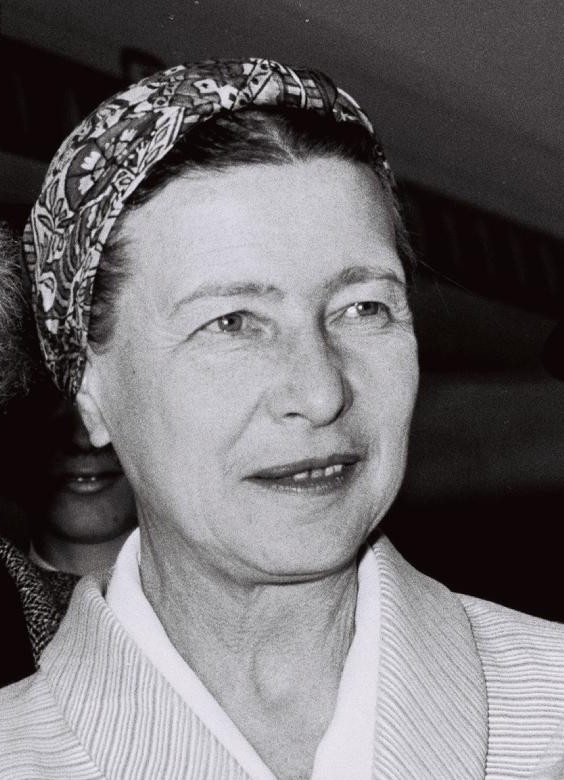

One is not born but becomes a woman.
Philosopher, novelist, activist and public intellectual, Simone de Beauvoir was, with Jean-Paul Sartre, one of the leading existentialists of post-war France. Her philosophical ideas run through her novels, from She Came to Stay (1943) to The Mandarins, which won the Prix Goncourt, as well as her essays such as The Ethics of Ambiguity (1947).
The Second Sex (1949) is a founding work of feminist philosophy. Arguing that “one is not born, but rather becomes, a woman”, it examines how women have been made the “Other” to men in biology, history, myth and lived experience, drawing on existentialist and phenomenological ideas about freedom and embodiment.
Key ideas
- “One is not born, but becomes a woman”
- The most famous line of The Second Sex is often credited with alerting us to the distinction between sex and gender. The book gives us a vocabulary for analysing how society’s notions of femininity are lived.
- Woman as Other
- European science, literature, religion and politics have produced impossible and conflicting ideals of femininity, and an ideology of women’s “natural” inferiority that justifies patriarchal domination. Woman is made the Other to man.
- The ethics of ambiguity
- We exist alone and without guarantees, yet we are free, and freedom brings reciprocity and responsibility towards others. For Beauvoir, existentialism was the one philosophy that took the question of evil seriously.
- Freedom in situation
- Beauvoir came to criticise her early ethics as too abstract. Freedom is always lived in a concrete social situation, and people can be alienated from their freedom by the conditions they live in.
- Old age as Other
- In The Coming of Age, Beauvoir argued that ageing is inescapable, but the Otherness of old age is not. It comes from cultural stigma and society’s loathing of ageing.
- Tradition
- Western
- Region
- Paris
- Period
- Contemporary
Influences
Influenced by
- René Descartes1596–1650
- Immanuel Kant1724–1804
- G. W. F. Hegel1770–1831
- Søren Kierkegaard1813–1855
- Karl Marx1818–1883
- Martin Heidegger1889–1976
- Jean-Paul Sartre1905–1980
Simone de Beauvoir1908–1986
Influenced by
- René Descartes1596–1650
- Immanuel Kant1724–1804
- G. W. F. Hegel1770–1831
- Søren Kierkegaard1813–1855
- Karl Marx1818–1883
- Martin Heidegger1889–1976
- Jean-Paul Sartre1905–1980
Simone de Beauvoir1908–1986
Where these links come from
- Simone de Beauvoir drew on René Descartes. Source: Debra Bergoffen and Megan Burke, Simone de Beauvoir, Stanford Encyclopedia of Philosophy
- Simone de Beauvoir drew on Immanuel Kant. Source: Debra Bergoffen and Megan Burke, Simone de Beauvoir, Stanford Encyclopedia of Philosophy
- Simone de Beauvoir drew on G. W. F. Hegel. Source: Debra Bergoffen and Megan Burke, Simone de Beauvoir, Stanford Encyclopedia of Philosophy
- Simone de Beauvoir drew on Søren Kierkegaard. Source: Debra Bergoffen and Megan Burke, Simone de Beauvoir, Stanford Encyclopedia of Philosophy
- Simone de Beauvoir drew on Karl Marx. Source: Debra Bergoffen and Megan Burke, Simone de Beauvoir, Stanford Encyclopedia of Philosophy
- Simone de Beauvoir drew on Martin Heidegger. Source: Debra Bergoffen and Megan Burke, Simone de Beauvoir, Stanford Encyclopedia of Philosophy
- Simone de Beauvoir drew on Jean-Paul Sartre. Source: Debra Bergoffen and Megan Burke, Simone de Beauvoir, Stanford Encyclopedia of Philosophy
Key works
- The Ethics of Ambiguity (Pour une morale de l’ambiguïté), 1947
- The Second Sex (Le Deuxième Sexe), 1949
Sources
- Debra Bergoffen and Megan Burke, Simone de Beauvoir, Stanford Encyclopedia of Philosophy