Philosopher
Albert Camus
1913–1960
French novelist, journalist and philosopher of the absurd, who asked whether life is worth living in a silent universe and answered with revolt.
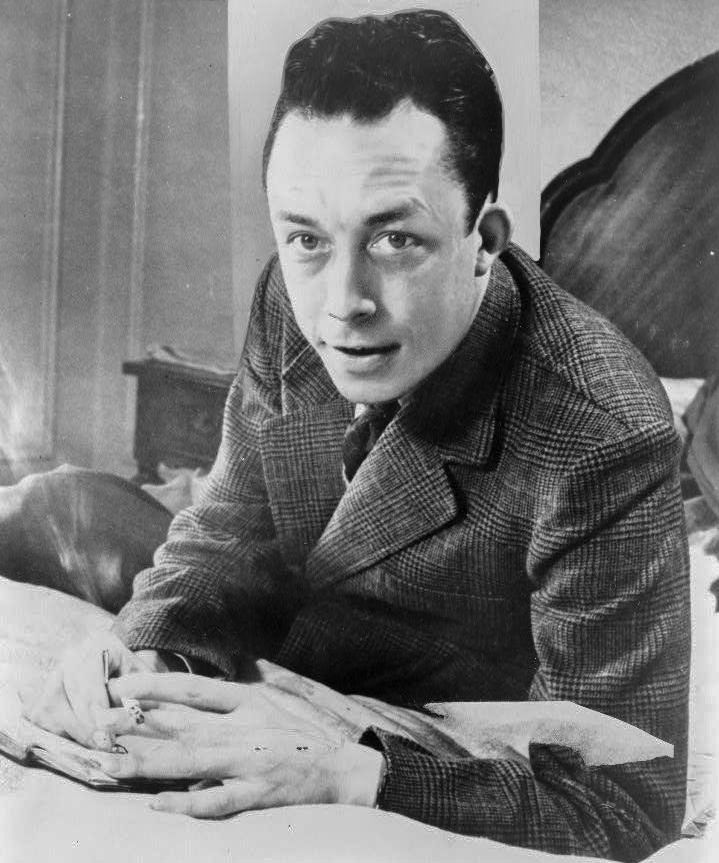

There is only one really serious philosophical problem, and that is suicide. Deciding whether or not life is worth living is to answer the fundamental question in philosophy.
Camus wrote his graduate thesis at the University of Algiers, on Plotinus and Augustine. The Communist Party expelled him in the mid-1930s when he refused to go along with its policy of playing down French colonialism in Algeria, and his first philosophical essays, Nuptials, appeared there in 1938. In 1944 he became editor of Combat, the chief clandestine paper of the non-Communist left, and worked on The Plague, whose obvious content, he said, was the struggle of the Resistance against Nazism.
He was a journalist, playwright, novelist and essayist, and denied more than once that he was a philosopher. The Rebel led to a break with his friend Jean-Paul Sartre that became the great intellectual divide of the Cold War, between the anti-Communist and the pro-Communist left. He received the Nobel Prize for Literature in 1957, and was killed in a car crash early in 1960, aged 46.
Key ideas
- The absurd
- Human beings cannot help asking what existence means, but the universe is silent. The absurd is this clash between our need for meaning and the impossibility of finding any; we must learn to bear an emptiness that cannot be filled.
- The one serious question
- Whether life is worth living is the fundamental question of philosophy, and everything else follows from it. For Camus the result of philosophy is action, not only understanding.
- Sisyphus
- Sisyphus, forever pushing his rock uphill only to watch it roll back, embodies the absurd. His scorn for the gods and passion for life make his futile labour a triumph; we can live with a crushing fate without resigning ourselves to it.
- No leap of faith
- Existentialists such as Kierkegaard, Jaspers and Heidegger start from the absurdity of the human condition but then escape it through hope. “They deify what crushes them”, Camus wrote, and their “forced hope is religious in all of them”.
- Rebellion
- In an “age of ideologies”, Camus turned from suicide to murder. Revolt against oppression, injustice and a meaningless universe is a primary fact of human experience, but in The Rebel he criticised politics that sacrifice the present to a utopian future, above all Communism.
- Tradition
- Western
- Region
- French Algeria and France
- Period
- Contemporary
Influences
Influenced by
- Søren Kierkegaard1813–1855criticised
- Edmund Husserl1859–1938criticised
- Martin Heidegger1889–1976criticised
- Jean-Paul Sartre1905–1980criticised
Albert Camus1913–1960
Influenced by
- Søren Kierkegaard1813–1855criticised
- Edmund Husserl1859–1938criticised
- Martin Heidegger1889–1976criticised
- Jean-Paul Sartre1905–1980criticised
Albert Camus1913–1960
Where these links come from
- Albert Camus argued against Søren Kierkegaard. Source: Ronald Aronson, Albert Camus, Stanford Encyclopedia of Philosophy
- Albert Camus argued against Edmund Husserl. Source: Ronald Aronson, Albert Camus, Stanford Encyclopedia of Philosophy
- Albert Camus argued against Martin Heidegger. Source: Ronald Aronson, Albert Camus, Stanford Encyclopedia of Philosophy
- Albert Camus argued against Jean-Paul Sartre. Source: Ronald Aronson, Albert Camus, Stanford Encyclopedia of Philosophy
Key works
- Nuptials (Noces), 1938
- The Stranger (L'Étranger)
- The Myth of Sisyphus (Le Mythe de Sisyphe)
- The Plague (La Peste), 1947
- The Rebel (L'Homme révolté)
- The Fall (La Chute)
Sources
- Ronald Aronson, Albert Camus, Stanford Encyclopedia of Philosophy