Philosopher
William James
1842–1910
Psychologist and philosopher whose Principles of Psychology described the 'stream of thought', and who made pragmatism famous with a theory of truth as what works.
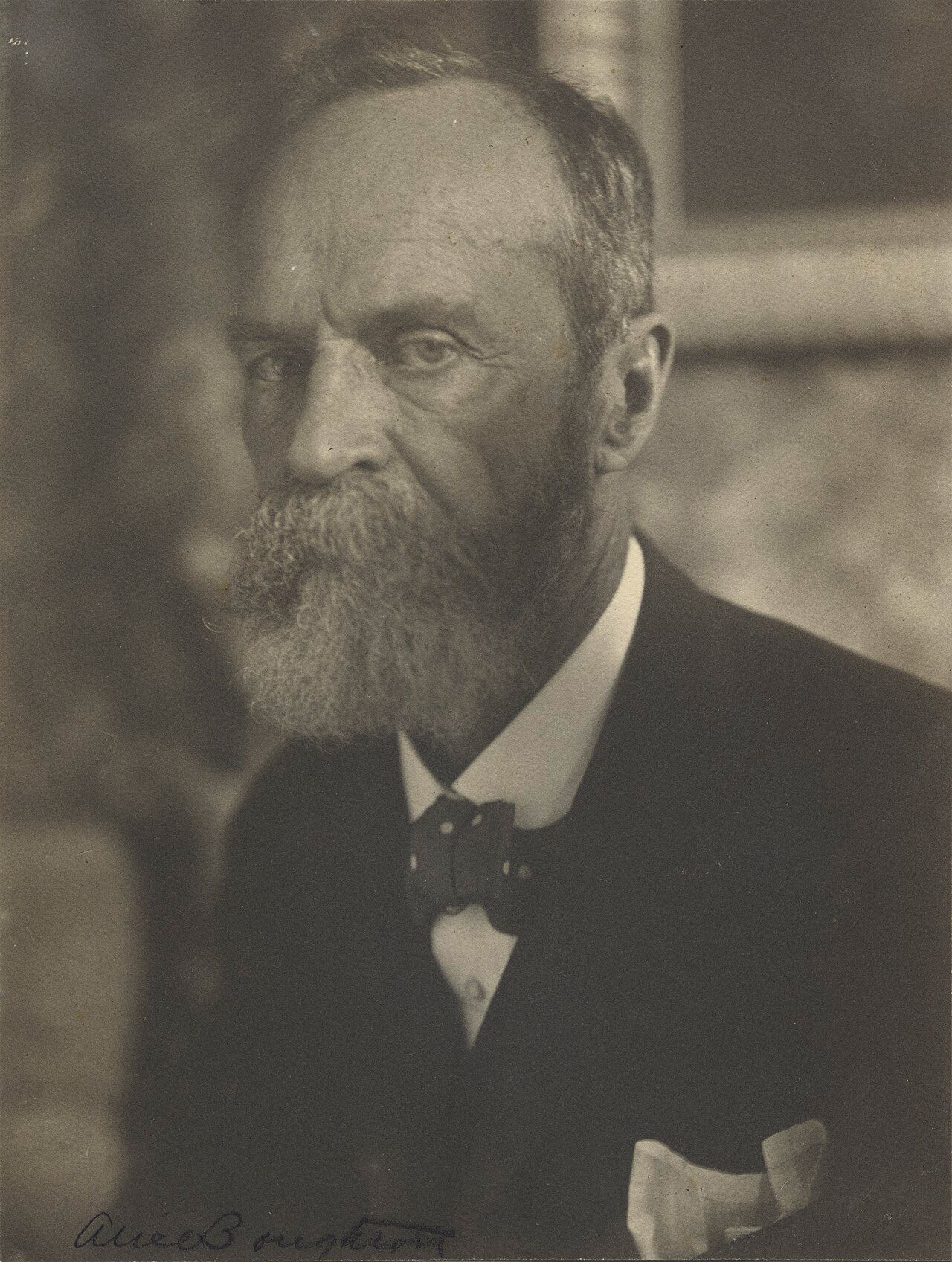
.jpg)
‘The true,’ to put it very briefly, is only the expedient in the way of our thinking, just as ‘the right’ is only the expedient in the way of our behaving.
William James was born in New York City in 1842, the eldest of the children of Henry James and his wife Mary, and a year older than his brother Henry. He studied painting before turning to science, took a medical degree at Harvard in 1869 but never practised, and went through years of depression and ill health. He began teaching at Harvard in 1872, set up the first American psychology laboratory, and after twelve years’ work published The Principles of Psychology in 1890.
He turned increasingly to philosophy and religion, announcing his pragmatism in 1898, giving the Gifford lectures that became The Varieties of Religious Experience, and opposing American policy in the Philippines. He died in 1910. His ideas reached well beyond pragmatism: Husserl took up his notion of the “fringe”, Russell drew on his “pure experience”, and Wittgenstein learned from his psychology.
Key ideas
- The stream of thought
- In his chapter on “The Stream of Thought”, James offered a richer account of experience than empiricists such as Hume. We experience relations, tendencies and vague “fringes” directly, a claim he later developed as “radical empiricism”.
- The right to believe
- Science can wait for the evidence, but some questions are “forced” and “momentous”, and there we have the right to believe before the evidence is in. On an icy mountain ledge, believing I can cross may help me succeed.
- Truth as a kind of good
- True beliefs are those we can “ride” into the future without unpleasant surprises; truth is “a species of the good”, made in the course of experience. Yet we do not make truths out of nothing, since experience and prior belief resist us.
- Pure experience
- Mind and matter are not two fundamental kinds of thing. Both are formed from “pure experience”, which is neither mental nor physical; whether a piece of it counts as part of a mind or of an object depends on its relations.
- Varieties of religious experience
- James studied religion as the feelings and experiences of individuals, contrasting the “healthy-minded”, with their sense of the goodness of life, with the “sick soul”, for whom radical evil is real.
- Tradition
- Western
- Region
- United States
- Schools
- Pragmatism
- Period
- Late modern
Influences
Influenced by
- David Hume1711–1776criticised
- Immanuel Kant1724–1804
- Charles Sanders Peirce1839–1914
- Henri Bergson1859–1941
William James1842–1910
Influenced
Influenced by
- David Hume1711–1776criticised
- Immanuel Kant1724–1804
- Charles Sanders Peirce1839–1914
- Henri Bergson1859–1941
William James1842–1910
Influenced
Where these links come from
- William James argued against David Hume. Source: Russell Goodman, William James, Stanford Encyclopedia of Philosophy
- William James drew on Immanuel Kant. Source: Russell Goodman, William James, Stanford Encyclopedia of Philosophy
- William James drew on Charles Sanders Peirce. Source: Russell Goodman, William James, Stanford Encyclopedia of Philosophy
- William James drew on Henri Bergson. Source: Russell Goodman, William James, Stanford Encyclopedia of Philosophy
- Edmund Husserl drew on William James. Source: Russell Goodman, William James, Stanford Encyclopedia of Philosophy
- John Dewey drew on William James. Source: David Hildebrand, John Dewey, Stanford Encyclopedia of Philosophy
- Alfred North Whitehead drew on William James. Source: Ronald Desmet and Andrew David Irvine, Alfred North Whitehead, Stanford Encyclopedia of Philosophy
- Bertrand Russell drew on William James. Source: Andrew David Irvine, Bertrand Russell, Stanford Encyclopedia of Philosophy
- Ludwig Wittgenstein drew on William James. Source: Russell Goodman, William James, Stanford Encyclopedia of Philosophy
Key works
- The Principles of Psychology, 1890
- Read free at Project Gutenberg (volume 1 of 2)
- The Will to Believe, 1897
- The Varieties of Religious Experience, 1902
- Pragmatism, 1907
Sources
- Russell Goodman, William James, Stanford Encyclopedia of Philosophy
- Catherine Legg and Christopher Hookway, Pragmatism, Stanford Encyclopedia of Philosophy
- Leonard Lawlor and Valentine Moulard-Leonard, Henri Bergson, Stanford Encyclopedia of Philosophy