Philosopher
Charles Sanders Peirce
1839–1914
Also known as C. S. Peirce
Logician, scientist and founder of American pragmatism, who held that a concept's meaning lies in its conceivable practical effects, and who developed a general theory of signs.
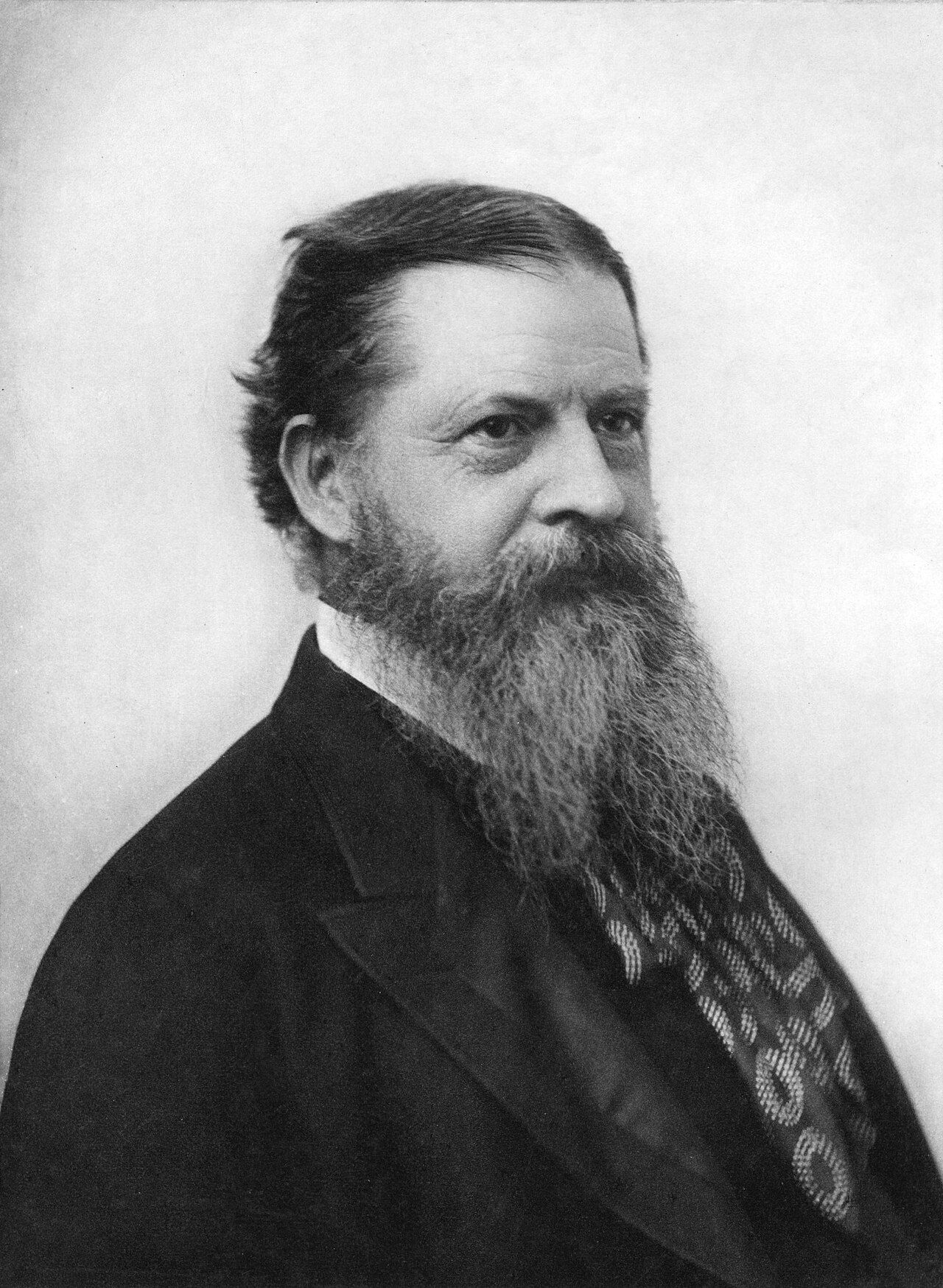

Consider what effects, which might conceivably have practical bearings, we conceive the object of our conception to have. Then, our conception of these effects is the whole of our conception of the object.
Peirce was born in Cambridge, Massachusetts, in 1839, the son of the Harvard mathematician Benjamin Peirce, who educated him largely by setting him problems. He took a degree in chemistry at Harvard and for thirty-two years worked for the United States Coast and Geodetic Survey, making precise measurements of gravity, while regarding logic as his real vocation. From 1879 to 1884 he also taught logic at Johns Hopkins University, where his students included John Dewey; he lost the post, his only academic job, apparently over the circumstances of his second marriage.
After his government work ended in 1891 he often lived close to poverty, and he died in Milford, Pennsylvania, in 1914. He left some 12,000 printed pages and about 80,000 pages of manuscript on subjects from mathematics and astronomy to psychology and economics. His papers in Popular Science Monthly in 1877 and 1878 first set out the ideas of pragmatism; when the name spread to views he did not share, he renamed his own “pragmaticism”.
Key ideas
- The pragmatic maxim
- The whole meaning of a clear concept lies in its conceivable practical consequences, the observations we would expect under given conditions. To call a thing “hard” is to say, among other things, that many substances will not scratch it.
- Deduction, induction and abduction
- Besides deduction and induction there is a third kind of inference, abduction or hypothesis, which has the air of an educated guess. Deduction runs from a population to a sample, induction from a sample to a population; abduction conjectures how a case might be explained.
- Chance is real
- Measurement never gives the same result twice, and the finer the instruments, the more the results vary. Peirce concluded that the universe shows habits, regularities of varying strength, but not deterministic law: chance is a real feature of the world.
- Signs
- A sign relation always has three terms: an object, the sign that represents it, and an “interpretant”, itself a sign of the same object to a further interpretant. Peirce’s “semeiotic” is a different theory from the semiotics of Saussure.
- Firstness, secondness, thirdness
- Peirce sorted everything into threes. Quality is a first, fact a second and habit or law a third; possibility, actuality and necessity follow the same pattern.
- Tradition
- Western
- Region
- United States
- Schools
- Pragmatism
- Period
- Late modern
Influences
Influenced by
Charles Sanders Peirce1839–1914
Influenced
Influenced by
Charles Sanders Peirce1839–1914
Influenced
Where these links come from
- Charles Sanders Peirce drew on John Duns Scotus. Source: Robert Burch, Charles Sanders Peirce, Stanford Encyclopedia of Philosophy
- Charles Sanders Peirce drew on and argued against Immanuel Kant. Source: Robert Burch, Charles Sanders Peirce, Stanford Encyclopedia of Philosophy
- William James drew on Charles Sanders Peirce. Source: Russell Goodman, William James, Stanford Encyclopedia of Philosophy
- John Dewey drew on Charles Sanders Peirce. Source: David Hildebrand, John Dewey, Stanford Encyclopedia of Philosophy
Key works
- The Fixation of Belief, 1877
- Read free at Project Gutenberg (in Chance, Love, and Logic, edited by Morris R. Cohen (1923))
- How to Make Our Ideas Clear, 1878
- Read free at Project Gutenberg (in Chance, Love, and Logic, edited by Morris R. Cohen (1923))
Sources
- Robert Burch, Charles Sanders Peirce, Stanford Encyclopedia of Philosophy
- Catherine Legg and Christopher Hookway, Pragmatism, Stanford Encyclopedia of Philosophy