Philosopher
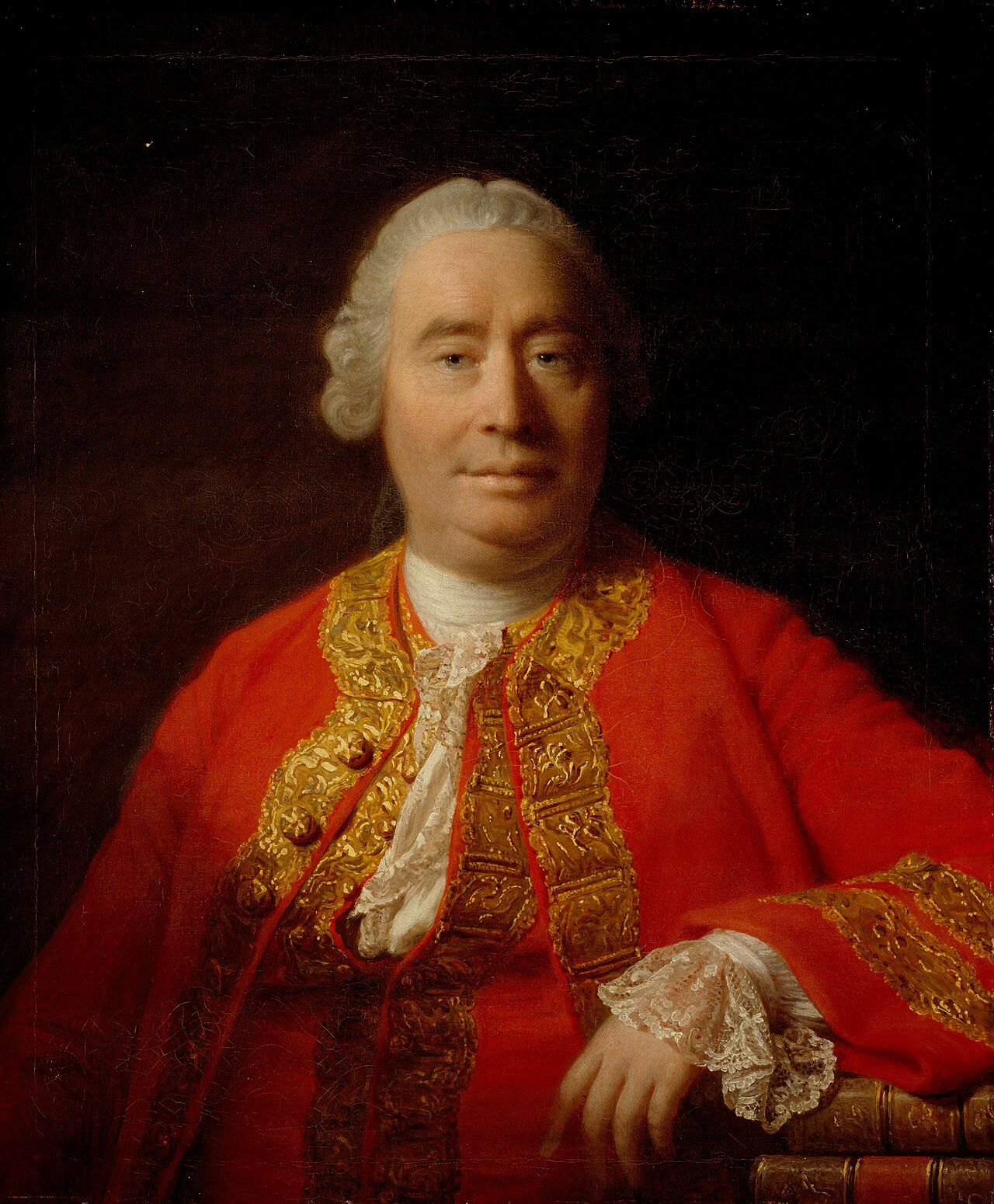
David Hume
1711–1776
Scottish empiricist and sceptic who argued that our beliefs about cause and effect rest on habit rather than reason.

Reason is, and ought only to be the slave of the passions, and can never pretend to any other office than to serve and obey them.
Hume set out to build a “science of man” on the basis of experience. He argued that we never observe any necessary connection between a cause and its effect, only one kind of event regularly following another, so our expectation that the future will resemble the past is a matter of custom. He applied the same scrutiny to the self, to morality — which he grounded in sentiment rather than reason — and to arguments for the existence of God.
His Dialogues Concerning Natural Religion was published after his death.
Key ideas
- The problem of induction
- All our inferences about the unobserved rest on the assumption “that the future will be conformable to the past”. Reason can’t justify that assumption; our expectations come from “custom or habit”.
- Cause and effect
- We never observe a necessary connection between cause and effect. Seeing events repeatedly joined produces only a feeling of expectation in us, which we project onto the world.
- “Hume’s fork”
- Knowledge divides into “relations of ideas”, such as 2 + 2 = 4, which are true whatever the world is like, and “matters of fact”, such as that sharks eat meat, which only experience can establish and whose denial is no contradiction.
- The self as a bundle
- Looking inwards, we find no idea of a self underlying our perceptions. The self is a bundle, or succession, of associated perceptions, though Hume later voiced doubts about this theory.
- Morality rests on feeling
- Reason alone can never move us to act, but morality does. So “the rules of morality … are not conclusions of our reason”: moral distinctions come from sentiment.
- Tradition
- Western
- Region
- Scotland
- Schools
- Empiricism
- Period
- Early modern
Influences
Influenced by
David Hume1711–1776
Influenced
Influenced by
David Hume1711–1776
Influenced
Where these links come from
- David Hume drew on Cicero. Source: Raphael Woolf, Cicero, Stanford Encyclopedia of Philosophy
- David Hume drew on John Locke. Source: Hsueh Qu and Elizabeth S. Radcliffe, David Hume, Stanford Encyclopedia of Philosophy
- David Hume drew on and argued against Nicolas Malebranche. Source: Hsueh Qu and Elizabeth S. Radcliffe, David Hume, Stanford Encyclopedia of Philosophy
- David Hume drew on George Berkeley. Source: Lisa Downing and David Hilbert, George Berkeley, Stanford Encyclopedia of Philosophy
- Adam Smith drew on and argued against David Hume. Source: Samuel Fleischacker, Adam Smith's Moral and Political Philosophy, Stanford Encyclopedia of Philosophy
- Immanuel Kant drew on and argued against David Hume. Source: Graciela De Pierris and Michael Friedman, Kant and Hume on Causality, Stanford Encyclopedia of Philosophy
- Jeremy Bentham drew on David Hume. Source: James E. Crimmins, Jeremy Bentham, Stanford Encyclopedia of Philosophy
- William James argued against David Hume. Source: Russell Goodman, William James, Stanford Encyclopedia of Philosophy
- Alfred North Whitehead argued against David Hume. Source: Ronald Desmet and Andrew David Irvine, Alfred North Whitehead, Stanford Encyclopedia of Philosophy
- Karl Popper drew on David Hume. Source: Stephen Thornton, Karl Popper, Stanford Encyclopedia of Philosophy
- Elizabeth Anscombe argued against David Hume. Source: Eric Wiland and Julia Driver, Gertrude Elizabeth Margaret Anscombe, Stanford Encyclopedia of Philosophy
Key works
- A Treatise of Human Nature, 1739
- An Enquiry Concerning Human Understanding, 1748
- Dialogues Concerning Natural Religion, 1779
Sources
- Hsueh Qu and Elizabeth S. Radcliffe, David Hume, Stanford Encyclopedia of Philosophy
- Lisa Downing and David Hilbert, George Berkeley, Stanford Encyclopedia of Philosophy
- Raphael Woolf, Cicero, Stanford Encyclopedia of Philosophy