Philosopher
Alfred North Whitehead
1861–1947
Mathematician who wrote Principia Mathematica with Russell, then turned to metaphysics at Harvard and founded process philosophy, which treats the world as interdependent events rather than things.
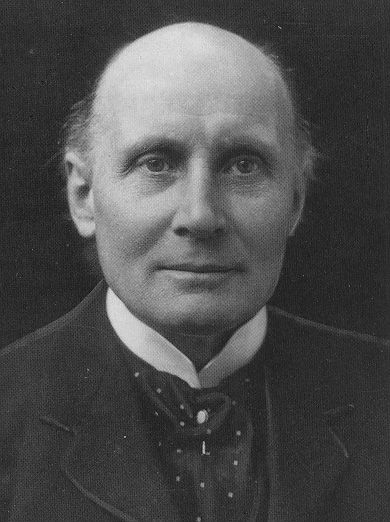

There is an error; but it is merely the accidental error of mistaking the abstract for the concrete. It is an example of what I will call the ‘Fallacy of Misplaced Concreteness.’
Whitehead, the son of an Anglican clergyman, graduated from Cambridge in 1884 and taught at Trinity College for a quarter of a century. Bertrand Russell arrived as his student in 1890 and remembered him as an extraordinarily good teacher; others he taught, examined or supervised included the economist John Maynard Keynes and the philosophers Nelson Goodman and W. V. O. Quine. From 1910 to 1924 he worked in London on physics, the philosophy of science and education.
In 1924, facing compulsory retirement, he accepted a chair of philosophy at Harvard. “In England,” Russell remarked, “Whitehead was regarded only as a mathematician, and it was left to America to discover him as a philosopher.” His Lowell Lectures at Harvard became Science and the Modern World, and his Gifford Lectures at Edinburgh became Process and Reality. He founded no school in his lifetime, but after his death in 1947 his ideas inspired the movements of process philosophy and process theology.
Key ideas
- The logical foundations of mathematics
- With his former student Bertrand Russell, Whitehead wrote the three-volume Principia Mathematica (1910–1913), a landmark attempt to set out the logical foundations of mathematics.
- Against the bifurcation of nature
- Science had split nature into a world of primary qualities and a world of secondary ones. Whitehead rejected the split and Newton’s “scientific materialism”, arguing that perception gives us not only colours and sounds but relations, including causal relations, which Hume had denied we perceive.
- The fallacy of misplaced concreteness
- Much confusion in philosophy comes from “mistaking the abstract for the concrete”, treating abstractions such as bits of matter simply located in space as though they were the concrete facts of nature.
- Process
- The world is made not of independent material things but of deeply interdependent processes and events. Its ultimate units are “actual occasions”, organism-like elementary processes in terms of which Whitehead sought to understand matter and mind, science and religion.
- Religion is not necessarily good
- Whitehead warned against the “dangerous delusion” that religion is necessarily good, listing the horrors that have attended it. Yet he did not think it merely negative, and hoped philosophy could fuse religion and science into one rational scheme.
- Tradition
- Western
- Region
- England and United States
- Period
- Contemporary
- Themes
- What is ultimately real
Influences
Influenced by
Alfred North Whitehead1861–1947
Influenced
Influenced by
Alfred North Whitehead1861–1947
Influenced
Where these links come from
- Alfred North Whitehead argued against David Hume. Source: Ronald Desmet and Andrew David Irvine, Alfred North Whitehead, Stanford Encyclopedia of Philosophy
- Alfred North Whitehead drew on William James. Source: Ronald Desmet and Andrew David Irvine, Alfred North Whitehead, Stanford Encyclopedia of Philosophy
- Alfred North Whitehead drew on Henri Bergson. Source: Ronald Desmet and Andrew David Irvine, Alfred North Whitehead, Stanford Encyclopedia of Philosophy
- W. V. O. Quine drew on Alfred North Whitehead. Source: Peter Hylton and Gary Kemp, Willard Van Orman Quine, Stanford Encyclopedia of Philosophy
Key works
- Principia Mathematica, 1910
- The Concept of Nature, 1920
- Science and the Modern World, 1925
- Process and Reality, 1929
- Adventures of Ideas, 1933
Sources
- Ronald Desmet and Andrew David Irvine, Alfred North Whitehead, Stanford Encyclopedia of Philosophy