Philosopher
Epictetus
c. 55 – c. 135 CE
Former slave turned Stoic teacher, who taught that our freedom lies entirely in our own choices and judgements, and that everything else is outside our control.
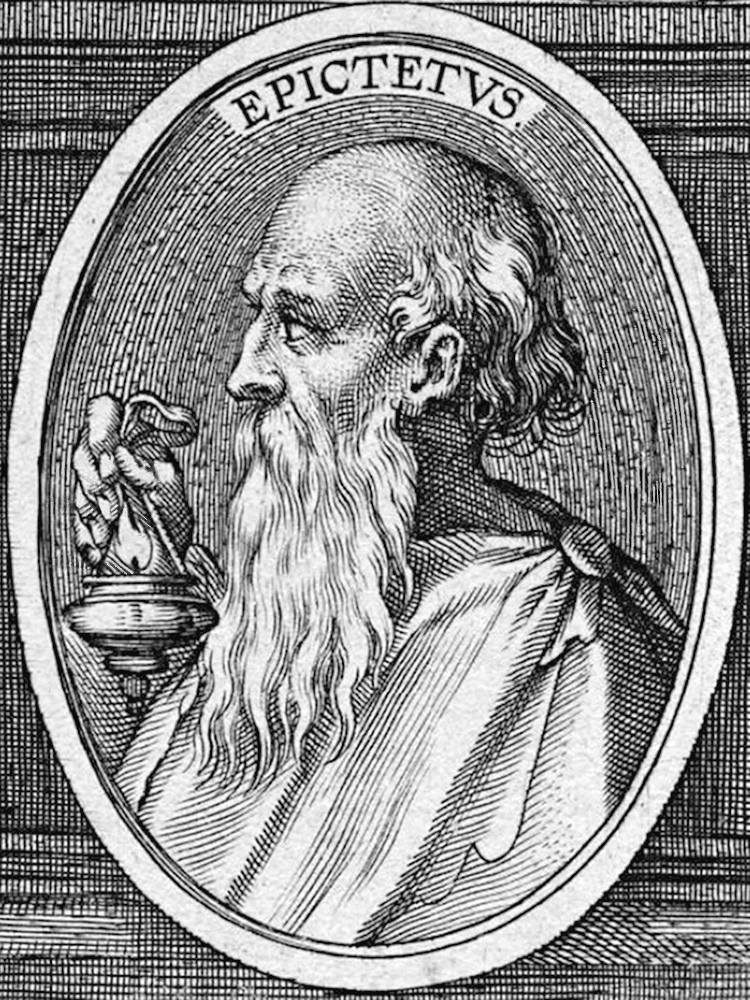

Men are disturbed not by the things which happen, but by the opinions about the things.
Born in the 50s CE in the Greek city of Hierapolis in Asia Minor, Epictetus was for part of his life enslaved to Epaphroditus, an official at Nero’s court. He studied with the Stoic Musonius Rufus in Rome and, once freed, began teaching there, until Domitian banned philosophers from Italy. He then opened his own school at Nicopolis in north-west Greece, where he taught until his death around 135.
He wrote nothing himself. His pupil Arrian recorded his teaching in the Discourses and summed it up in the short Encheiridion (“Handbook”). Drawing on the early Stoics and on the Socrates of Plato’s dialogues, Epictetus restated Stoic ethics with unusual force and consistency. The emperor Marcus Aurelius, though never his pupil, considered himself his follower, and the Encheiridion was widely read in Europe after its translation into Latin in 1497.
Key ideas
- What is up to us
- Our judgements, intentions and choices are truly ours; body, possessions, reputation and the success of our projects are “externals”. Freedom and happiness depend only on the first, so no one can harm the real self.
- Volition is our true self
- The capacity for choice (prohairesis), or volition, is by nature unimpeded, which makes freedom an inalienable feature of human beings. It is the volition, not the body, that is the real person.
- Emotions follow judgements
- Grief, fear and anger are not forced on us by events but come from false judgements that happiness lies outside ourselves. Correct the judgements and the feelings change, which is why one should pity a wrongdoer rather than be angry.
- Education for living
- Mastering books matters less than acquiring the habits that lead to right action. Moral progress needs no divine help; reason can correct itself through self-examination and repeated practice.
- Tradition
- Western
- Region
- Rome and Nicopolis, Greece
- Schools
- Stoicism
- Period
- Ancient Greek and Roman
Influences
Influenced by
Epictetusc. 55 – c. 135 CE
Influenced
Influenced by
Epictetusc. 55 – c. 135 CE
Influenced
Where these links come from
- Epictetus drew on Socrates. Source: Margaret Graver, Epictetus, Stanford Encyclopedia of Philosophy
- Epictetus drew on Diogenes of Sinope. Source: Julie Piering, Cynics, Internet Encyclopedia of Philosophy
- Epictetus drew on Chrysippus. Source: Margaret Graver, Epictetus, Stanford Encyclopedia of Philosophy
- Marcus Aurelius drew on Epictetus. Source: Rachana Kamtekar, Marcus Aurelius, Stanford Encyclopedia of Philosophy
- Blaise Pascal drew on and argued against Epictetus. Source: Margaret Graver, Epictetus, Stanford Encyclopedia of Philosophy
Key works
- Discourses
- Read free at Project Gutenberg (translated by George Long, a selection, with the Encheiridion)
- Encheiridion (Enchiridion)
- Read free at Project Gutenberg (translated by Thomas Wentworth Higginson)