Philosopher
Nicholas of Cusa
1401–1464
Also known as Nicolaus Cusanus, Cusanus, Nikolaus von Kues, Nicolas of Cusa
Cardinal, church reformer and self-taught philosopher whose _On Learned Ignorance_ taught that the infinite God, in whom all opposites coincide, lies beyond every measure of the mind.
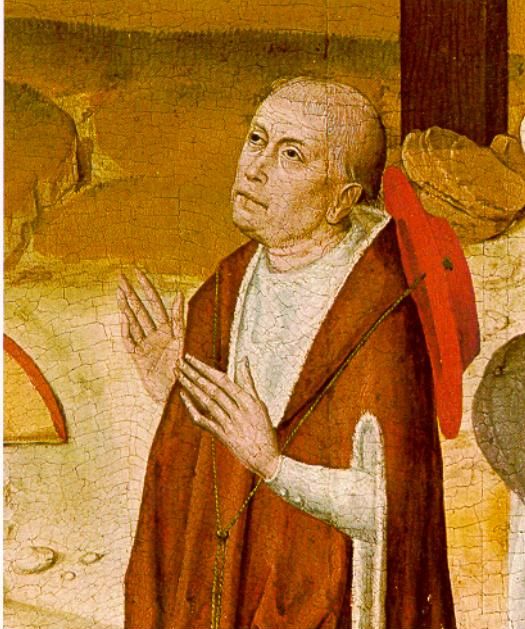

Insofar as He is the unfolding, in all things He is that which they are, just as in an image the reality itself is present.
Nicholas was born in 1401 in Kues, on the Moselle between Koblenz and Trier, the son of a prosperous merchant. He studied at Heidelberg and then canon law at Padua, taking his doctorate in 1423. In Cologne he proved the Donation of Constantine to be a forgery of the eighth century and was introduced to Ramon Llull, Albert the Great, Dionysius the Areopagite and Proclus. He first became known at the Council of Basel, where he argued for the council’s authority over the pope, but later changed sides. On his way back from an embassy to Constantinople in 1437, he had the insight that became On Learned Ignorance (1440). He was made a cardinal and papal legate to Germany, and from 1450 was bishop of Brixen, where his reforms met fierce resistance. He died at Todi in 1464; his heart was buried at the hospice he founded in Kues, which still houses his library.
Largely self-taught as a philosopher and theologian, he built his own Christian Neoplatonism through bold metaphors rather than scholastic argument, and also wrote on mathematics and reached out to Islam in On the Peace of Faith. His ideas anticipated later developments in cosmology and science, but apart from Giordano Bruno few thinkers took them up until the late nineteenth century.
Key ideas
- Learned ignorance
- “There is no proportion between finite and infinite.” Our minds know by measuring, comparing more and less, so they can never measure even a finite thing exactly, let alone God. Understanding why we cannot know is itself a kind of learning.
- The coincidence of opposites
- In God, maximum and minimum coincide, so God lies beyond the realm where the law of non-contradiction applies. A circle made infinitely large would coincide with a straight line, a mathematical image of how thought can reach past the finite.
- Enfolding and unfolding
- All things are enfolded in God’s simple unity and are an unfolding of God in space and time. The universe is a “contracted”, limited image of God’s absolute infinity, as a picture is an image of what it shows.
- The mind as measure
- The human mind is an image of God’s mind. God’s thinking creates things; ours creates concepts that assimilate them, so the mind “enfolds” all it knows and unfolds it as a world of ideas.
- Government by consent
- In The Catholic Concordance he argued that, since people are by nature equally free, all legitimate law and government come from the consent of the governed, and that a church council has authority over the pope.
- Tradition
- Western
- Region
- Kues, on the Moselle; Brixen; Rome
Influences
Influenced by
Nicholas of Cusa1401–1464
Influenced
Influenced by
Nicholas of Cusa1401–1464
Influenced
Where these links come from
- Nicholas of Cusa drew on Proclus. Source: Clyde Lee Miller, Cusanus, Nicolaus [Nicolas of Cusa], Stanford Encyclopedia of Philosophy
- Nicholas of Cusa drew on John Scottus Eriugena. Source: Dermot Moran and Adrian Guiu, John Scottus Eriugena, Stanford Encyclopedia of Philosophy
- Giordano Bruno drew on Nicholas of Cusa. Source: Dilwyn Knox, Giordano Bruno, Stanford Encyclopedia of Philosophy
Key works
- On Learned Ignorance (De docta ignorantia)
- The Catholic Concordance (De concordantia catholica)
- The Vision of God (De visione Dei)
- The Layman on Mind (Idiota de mente)
- On the Peace of Faith (De pace fidei)
Sources
- Clyde Lee Miller, Cusanus, Nicolaus [Nicolas of Cusa], Stanford Encyclopedia of Philosophy
- Dermot Moran and Adrian Guiu, John Scottus Eriugena, Stanford Encyclopedia of Philosophy