Philosopher
Gottlob Frege
1848–1925
Also known as Friedrich Ludwig Gottlob Frege
German logician who invented modern predicate logic, tried to derive arithmetic from logic, and distinguished the sense of an expression from what it refers to.
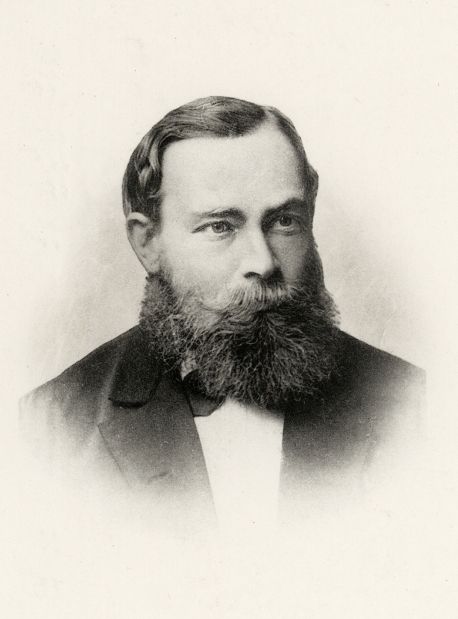

Frege was born in Wismar, on the Baltic coast of Germany, on 8 November 1848. He studied at Jena and Göttingen, took a doctorate in mathematics, and spent his whole career at the University of Jena. He died in Bad Kleinen on 26 July 1925.
Wanting to realise Leibniz’s dream of a universal formal language, Frege reconceived logic, and his formal system and philosophy of language became foundations of analytic philosophy. His great project of reducing mathematics to logic did not succeed, but his analysis of number, his definitions of the natural numbers and his account of sense and reference are still widely studied. Bertrand Russell refined his predicate calculus, and the young Ludwig Wittgenstein went to study with Russell on Frege’s advice.
Key ideas
- A new logic
- In his Begriffsschrift (1879) Frege built the first predicate calculus, a formal language able to analyse quantified statements such as “every number has a successor”, and defined a proof as a chain of steps each justified by an axiom or a rule.
- Numbers and concepts
- A statement of number is a statement about a concept. The same army can be counted as one army or five divisions, so “how many?” makes sense only once a concept is supplied.
- Arithmetic from logic
- Frege set out to show that arithmetic can be derived from logic alone. In 1902 Bertrand Russell showed that one of his axioms led to a contradiction, and the project in its original form failed, though many of his definitions and methods endured.
- Sense and reference
- “The morning star” and “the evening star” refer to the same planet but present it in different ways. An expression has a sense as well as a reference, which explains why “a = b” can be informative when “a = a” is not.
- Tradition
- Western
- Region
- Jena, Germany
- Period
- Late modern
Influences
Influenced by
Gottlob Frege1848–1925
Influenced
Influenced by
Gottlob Frege1848–1925
Influenced
Where these links come from
- Gottlob Frege drew on Gottfried Wilhelm Leibniz. Source: Edward N. Zalta, Gottlob Frege, Stanford Encyclopedia of Philosophy
- Bertrand Russell drew on Gottlob Frege. Source: Andrew David Irvine, Bertrand Russell, Stanford Encyclopedia of Philosophy
- Ludwig Wittgenstein drew on and argued against Gottlob Frege. Source: Anat Biletzki and Anat Matar, Ludwig Wittgenstein, Stanford Encyclopedia of Philosophy
- Rudolf Carnap studied with and drew on Gottlob Frege. Source: Hannes Leitgeb and André Carus, Rudolf Carnap, Stanford Encyclopedia of Philosophy
- Elizabeth Anscombe drew on Gottlob Frege. Source: Eric Wiland and Julia Driver, Gertrude Elizabeth Margaret Anscombe, Stanford Encyclopedia of Philosophy
Key works
- Concept-Script (Begriffsschrift), 1879
- The Foundations of Arithmetic (Die Grundlagen der Arithmetik), 1884
- On Sense and Reference (Über Sinn und Bedeutung), 1892
- On Concept and Object (Über Begriff und Gegenstand), 1892
- Read free at Wikisource (in German)
- Basic Laws of Arithmetic (Grundgesetze der Arithmetik), 1893
Sources
- Edward N. Zalta, Gottlob Frege, Stanford Encyclopedia of Philosophy
- Andrew David Irvine, Bertrand Russell, Stanford Encyclopedia of Philosophy
- Anat Biletzki and Anat Matar, Ludwig Wittgenstein, Stanford Encyclopedia of Philosophy