Philosopher
G. E. Moore
1873–1958
Also known as George Edward Moore
Cambridge philosopher who helped found analytic philosophy, argued that goodness cannot be defined in natural terms, and defended common sense against sceptics and idealists.
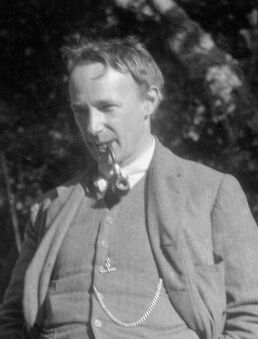
.jpg)
By far the most valuable things, which we know or can imagine, are certain states of consciousness, which may be roughly described as the pleasures of human intercourse and the enjoyment of beautiful objects.
Moore grew up in south London and went to Trinity College, Cambridge, in 1892 to study classics. Bertrand Russell and the idealist J. M. E. McTaggart encouraged him to add philosophy, and he briefly followed McTaggart and F. H. Bradley before breaking with idealism and leading Russell away from it too. With Russell and later Wittgenstein he made Cambridge a centre of what is now called analytic philosophy.
He became editor of Mind in 1921 and a professor at Cambridge in 1925, and was the most highly respected British philosopher of his time; Wittgenstein succeeded him in his chair in 1939. His friends in the Bloomsbury Group, among them Lytton Strachey, Leonard Woolf and Maynard Keynes, carried his influence into British culture. He was not a systematic philosopher, and his legacy is above all a collection of arguments, puzzles and challenges. He died in 1958.
Key ideas
- The naturalistic fallacy
- Goodness cannot be defined in natural terms such as pleasure, desire or the course of evolution. Whatever definition is offered, it remains an “open question” whether the thing defined is good, so goodness is indefinable and ethics is autonomous.
- The refutation of idealism
- Against the British idealists he had once followed, Moore held that what we think about is independent of our thinking of it. Propositions and concepts may be objects of thought, but “it is indifferent to their nature whether anybody thinks them or not”.
- The ideal
- The things with most intrinsic value include friendship and the appreciation of beauty. This deliberately unsystematic list, which leaves out social values such as equality and freedom, matched the Bloomsbury Group’s ideal of a life devoted to art and love.
- A defence of common sense
- Moore claimed to know for certain many truisms, such as that the earth existed long before his body was born. Philosophers who deny such knowledge, he argued, are incoherent, since they know these things too.
- Moore’s paradox
- It is absurd to say “It’s not raining but I believe that it is”, though the statement could be true of me. Wittgenstein saw that the puzzle touches our sense of ourselves as thinkers.
- Tradition
- Western
- Region
- England
- Period
- Contemporary
Influences
Influenced by
G. E. Moore1873–1958
Influenced
Influenced by
G. E. Moore1873–1958
Influenced
Where these links come from
- G. E. Moore argued against Immanuel Kant. Source: Tom Baldwin, George Edward Moore, Stanford Encyclopedia of Philosophy
- G. E. Moore argued against John Stuart Mill. Source: Tom Baldwin, George Edward Moore, Stanford Encyclopedia of Philosophy
- Bertrand Russell drew on G. E. Moore. Source: Andrew David Irvine, Bertrand Russell, Stanford Encyclopedia of Philosophy
Key works
- Principia Ethica, 1903
- The Refutation of Idealism, 1903
- A Defence of Common Sense, 1925
Sources
- Tom Baldwin, George Edward Moore, Stanford Encyclopedia of Philosophy