Philosopher
Pythagoras
c. 570 – c. 490 BCE
Also known as Pythagoras of Samos
Greek sage who taught that the soul is immortal and is reborn in other bodies, and founded a disciplined way of life; later legend made him the father of mathematics.
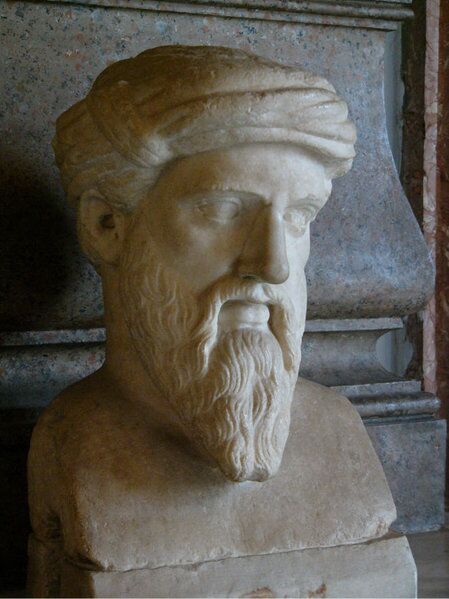

Stop, don’t keep hitting him, since it is the soul of a man who is dear to me, which I recognized, when I heard it yelping.
Pythagoras came from Samos, an island near today’s Turkish coast, and around the age of forty moved to Croton in southern Italy, where he did most of his philosophical work. He wrote nothing, and no contemporary gave a detailed account of his thought. From the first centuries BCE he was glorified as a semi-divine figure from whom all true philosophy flowed, and books were forged in his name, so recovering the historical Pythagoras means relying on the earliest evidence.
In that evidence he is famous not for mathematics but for his teaching on what becomes of the soul, for religious ritual, for wonders, including a reputed golden thigh, and for founding a way of life. His cosmos may have resembled those of the myths at the end of Plato’s Phaedo and Republic, and his successors Philolaus and Archytas developed it in a more scientific and mathematical direction.
Key ideas
- The immortal, migrating soul
- The soul is immortal and after death passes into new bodies, including those of other animals. This teaching of metempsychosis, or reincarnation, was what Pythagoras was best known for in his own day.
- All living things are kin
- Among his best-known doctrines, according to an early report, was that all animate beings belong to one family. It fits the story that he stopped a man beating a puppy because he recognised in its cries the soul of a friend.
- A way of life
- Pythagoras founded a strict way of life, with dietary rules, careful religious ritual and rigorous self-discipline, which still had followers more than a century after his death. It was probably meant to secure the best future lives.
- A cosmos of number and harmony
- The early evidence suggests a cosmos ordered by moral principles and numerical relationships, in which the heavens moved according to the ratios of musical harmony. Whether he did any real mathematics, such as proving the theorem named after him, is doubtful.
- Tradition
- Western
- Region
- Samos and Croton, southern Italy
- Schools
- Pythagoreanism
- Period
- Ancient Greek and Roman
Influences
Where these links come from
- Xenophanes argued against Pythagoras. Source: James Lesher, Xenophanes, Stanford Encyclopedia of Philosophy
- Empedocles drew on Pythagoras. Source: K. Scarlett Kingsley and Richard Parry, Empedocles, Stanford Encyclopedia of Philosophy
Sources
- Carl Huffman, Pythagoras, Stanford Encyclopedia of Philosophy