Philosopher
Montesquieu
1689–1755
Also known as Charles-Louis de Secondat, Baron de La Brède et de Montesquieu
Enlightenment political philosopher who explained forms of government by their causes, from climate to commerce, and argued that liberty needs separate legislative, executive and judicial powers.
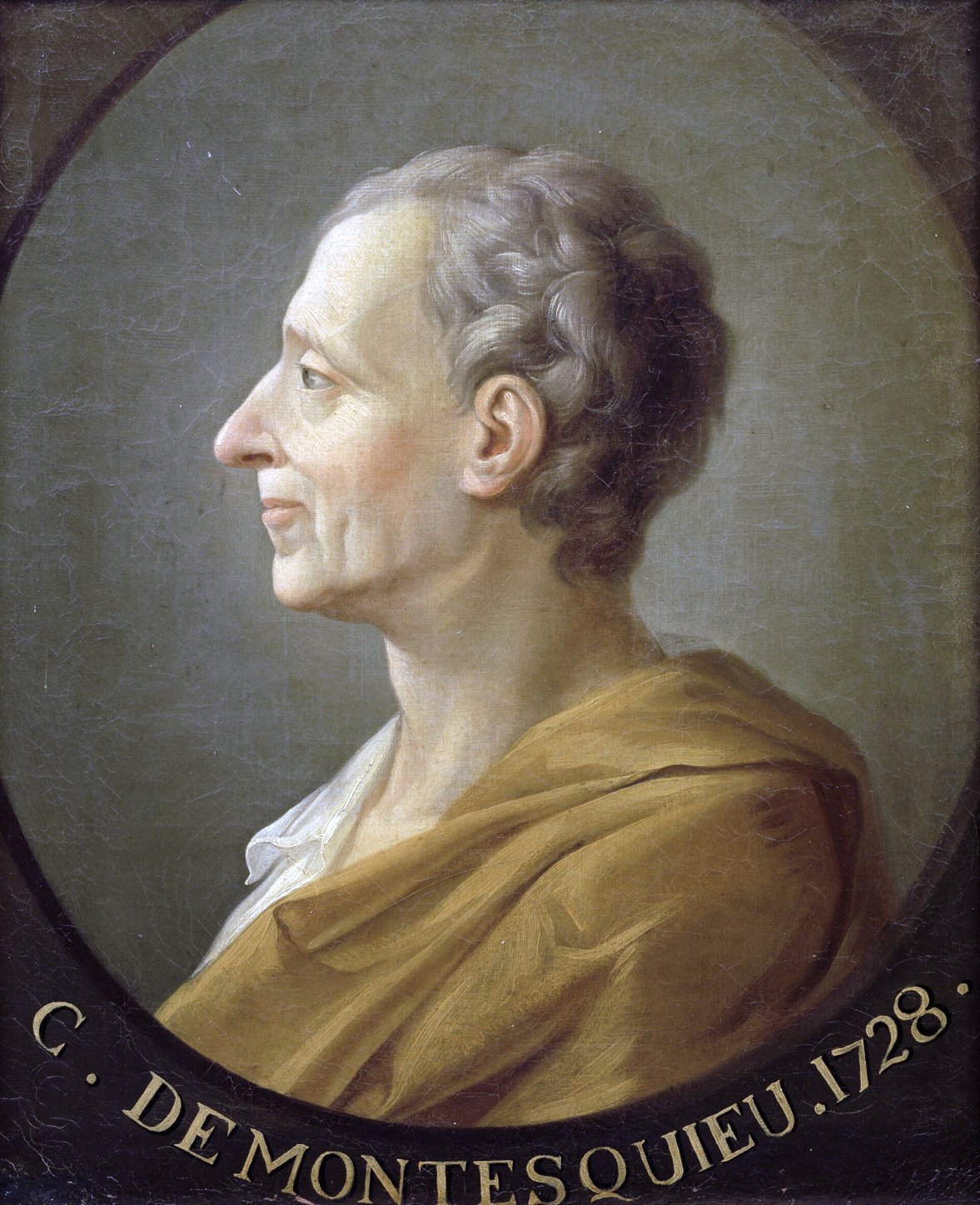

To prevent the abuse of power, it is necessary that by the very disposition of things power should be a check to power.
The political liberty of the subject is a tranquillity of mind, arising from the opinion each person has of his safety.
Charles-Louis de Secondat was born in 1689 at La Brède, near Bordeaux, into a prosperous noble family. He studied law at Bordeaux and in Paris, and in 1716 inherited from his uncle the title of Baron de Montesquieu and a senior judicial office in the Parlement of Bordeaux, where for eleven years he presided over the criminal court. His anonymous Persian Letters (1721), in which two Persian travellers describe the oddities of European life, made him a celebrity. He was elected to the Académie française in 1728, travelled across Europe and spent two years in England, whose constitution impressed him greatly.
Back at La Brède, with failing eyesight, he wrote The Spirit of the Laws (1748), a vast comparative study of laws and societies. It was controversial and hugely successful, and the Catholic Church put it on the Index in 1751. He died in Paris in 1755. His case for dividing the powers of government profoundly shaped liberal political thought and the men who drafted the US Constitution.
Key ideas
- Three kinds of government
- Governments are republics (democratic or aristocratic), monarchies and despotisms. A monarch differs from a despot by ruling through fixed, established laws, and each form rests on its own principle, such as virtue, honour or fear, and decays when that principle is undermined.
- Separation of powers
- Anyone given power tends to abuse it, so power must check power. Legislative, executive and judicial powers should belong to different bodies that can restrain one another, with an independent judiciary that simply applies the law.
- Liberty as security
- Political liberty is not doing whatever we like but the peace of mind that comes from feeling safe. It needs laws that are clear, that forbid only what threatens public order, and that leave citizens as much freedom as they can.
- Laws suited to their setting
- Climate, geography, commerce and religion shape a people’s temperament and customs, and laws must take them into account, working with their effects and counteracting the worst of them. They influence people without determining them.
- The gentle effects of commerce
- Trade, unlike conquest or mining colonial gold, sustains itself. It fosters frugality, moderation and order, cures destructive prejudices, softens manners and draws nations towards peace, and it benefits all countries except the very poorest.
- Tradition
- Western
- Region
- La Brède, near Bordeaux; Paris
- Period
- Early modern
Influences
Where these links come from
- Jean-Jacques Rousseau drew on Montesquieu. Source: Christopher Bertram, Jean Jacques Rousseau, Stanford Encyclopedia of Philosophy
Key works
- The Spirit of the Laws (De l'esprit des lois)
- Read free at Wikisource (translated by Thomas Nugent)
- Persian Letters (Lettres persanes)
- Considerations on the Causes of the Greatness of the Romans and their Decline
Sources
- Hilary Bok, Baron de Montesquieu, Charles-Louis de Secondat, Stanford Encyclopedia of Philosophy