Philosopher
Mary Wollstonecraft
1759–1797
English moral and political philosopher whose Vindication of the Rights of Woman argued that women, as rational beings, need the same education and rights as men.
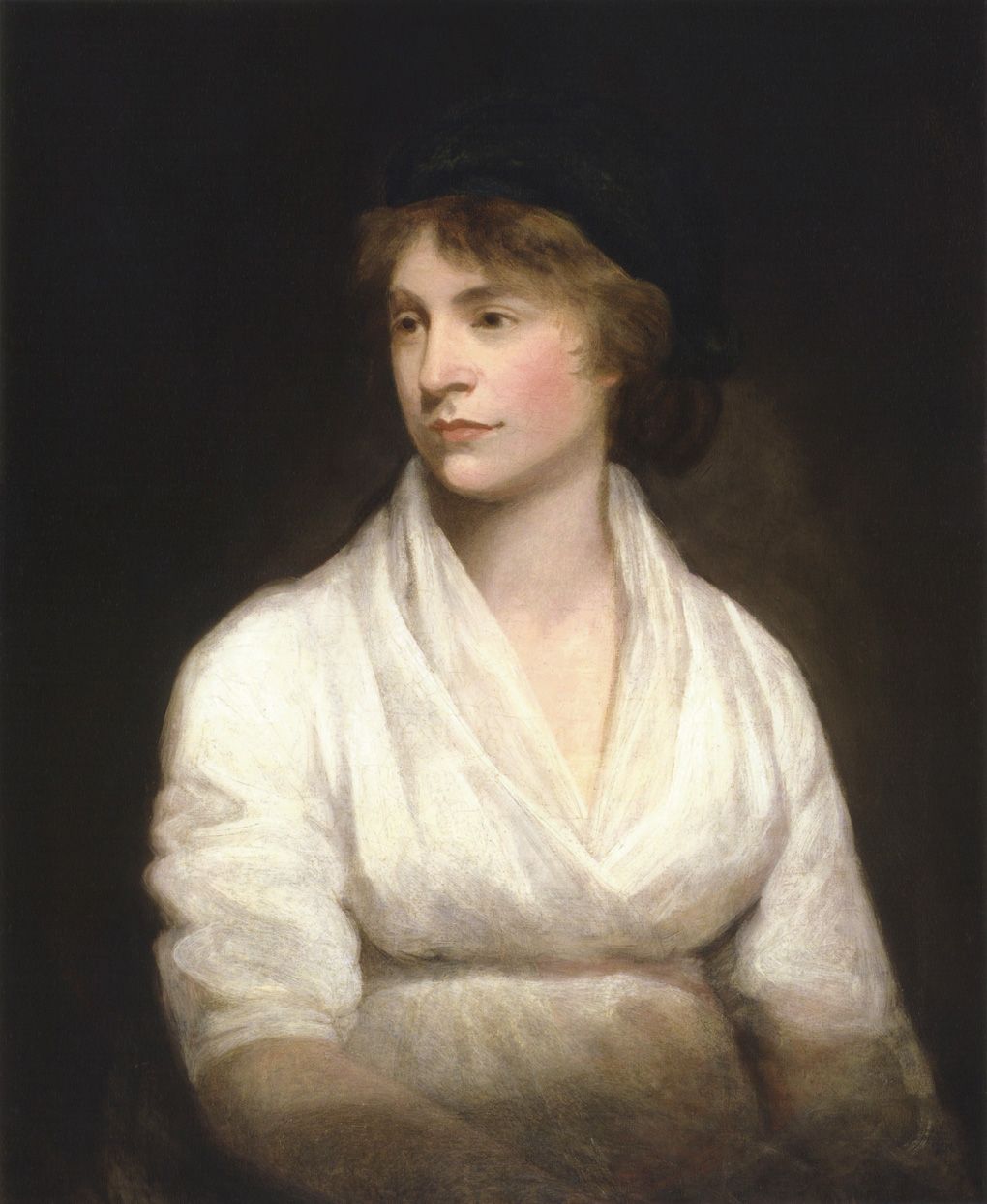
.jpg)
I do not wish them to have power over men; but over themselves.
Mary Wollstonecraft was born in 1759 in Spitalfields, in London. As her family’s fortunes fell she received little schooling, and she earned her living as a companion, a teacher and a governess, and found a publisher and patron in Joseph Johnson, for whose Analytical Review she wrote more than two hundred reviews. Through the Dissenting community at Newington Green she came to know the moral and political thinker Richard Price.
When Edmund Burke attacked Price and the French Revolution, her Vindication of the Rights of Men was the first of many replies; the Vindication of the Rights of Woman followed within months. In March 1797 she married William Godwin; their daughter, the future author of Frankenstein, was born that August, and Wollstonecraft died the same year. Derided by many in the nineteenth century, she is remembered above all for her contribution to feminism, and her ideas have been seriously assessed only since the second half of the twentieth.
Key ideas
- Women as rational beings
- Women are reasoning beings, made to seem otherwise by an upbringing that turns girls into “empty headed playthings”. Educated properly, they would be fully human, ruled by reason and self-command.
- Power over themselves
- Wollstonecraft did not want women to have power over men, but over themselves. Criticising the educational theories of her day, most notably Rousseau’s Emile, she wanted women taught to reason and to support themselves.
- The family and public morality
- A society devoted to property and display reproduces its corruption through the family. A genuinely moral society requires that men and women relate differently, both before marriage and within it.
- Rights and duties
- In the Lockean tradition, rights come from God, can be known by reason, and bring duties with them; but people whose natural rights are ignored cannot be expected to do their duties. Only institutions that pass the test of reason deserve obedience.
- Tradition
- Western
- Region
- London
- Period
- Early modern
Influences
Influenced by
Mary Wollstonecraft1759–1797
Influenced by
Mary Wollstonecraft1759–1797
Where these links come from
- Mary Wollstonecraft drew on and argued against John Locke. Source: Sylvana Tomaselli, Mary Wollstonecraft, Stanford Encyclopedia of Philosophy
- Mary Wollstonecraft drew on and argued against Jean-Jacques Rousseau. Source: Sylvana Tomaselli, Mary Wollstonecraft, Stanford Encyclopedia of Philosophy
Key works
- A Vindication of the Rights of Men, 1790
- A Vindication of the Rights of Woman, 1792
- Letters Written During a Short Residence in Sweden, Norway, and Denmark, 1796
Sources
- Sylvana Tomaselli, Mary Wollstonecraft, Stanford Encyclopedia of Philosophy