Philosopher
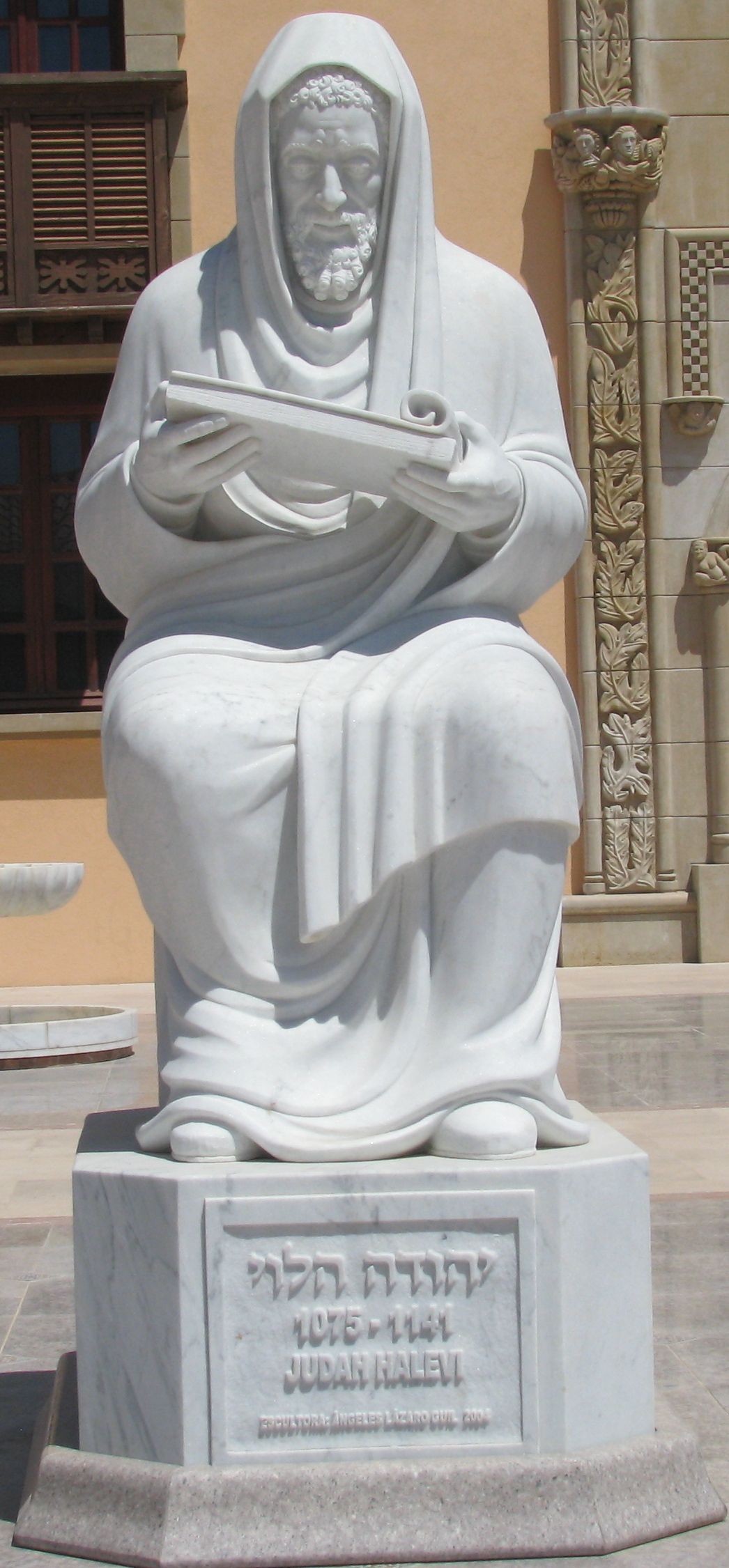
Judah Halevi
c. 1075 – 1141
Also known as Yehuda Halevi, Judah ha-Levi
Hebrew poet of the 'Golden Age of Spanish Jewry' whose Kuzari defends Judaism against the philosophers, holding that God is known through history and prophecy rather than proof.

Man yearns for Adonāi as a matter of love, taste, and conviction; whilst attachment to Elōhim is the result of speculation.
Little is known of most of Halevi’s life. He was probably born in Tudela, in the north of the Iberian peninsula, in the 1070s or early 1080s, and grew up in the Christian north. His talent as a poet won him entry to the Jewish elite of al-Andalus, and he is counted among the greatest Hebrew poets. He studied Jewish law in Lucena but earned his living as a physician, in Toledo and later in Córdoba.
In his last years he wrote many of his “Zion poems” and the Kuzari, a dialogue set at the court of the king of the Khazars, who questions a philosopher, a Christian, a Muslim and finally a Jewish sage. Halevi wrote it in Judaeo-Arabic, and in Judah ibn Tibbon’s Hebrew translation it became one of the most widely read works of Jewish theology. In 1140 he left Spain for the Land of Israel, stayed some months in Egypt, and sailed from Alexandria in May 1141; he probably died in the Land of Israel that summer.
Key ideas
- Faith independent of philosophy
- Halevi was the leading Jewish advocate of fideism: religious faith does not rest on reason. His fideism is moderate, since the philosophers do reach valid results in logic and mathematics, but not in the physics and metaphysics that matter for religion.
- Scepticism against the philosophers
- Halevi turns sceptical arguments on the philosophers. They disagree among themselves, they leave key points obscure, and on questions such as whether the world is eternal or created each argument meets an equally strong counter-argument.
- Signs of God in history
- Asked for his beliefs, the Jewish sage in the Kuzari points not to proofs but to the public signs of God’s presence in Israel’s history, such as the Exodus and the giving of the Torah. Those who were there saw them with their own senses, and later generations know them through tradition.
- The God of Abraham and the God of Aristotle
- Aristotle reached God through reasoning and knew him only as an obscure and doubtful theory. Abraham knew God through prophecy, an experience that changed his life. Only the way of prophecy, not the way of philosophy, truly leads to God.
- Tradition
- Jewish
- Region
- Al-Andalus and Christian Spain
- Period
- Judaeo-Arabic
Key works
- The Kuzari (Kitab al-radd wa-l-dalil fi l-din al-dhalil)
- Read free at Wikisource (translated by Hartwig Hirschfeld)
Sources
- Ehud Krinis, Judah Halevi, Stanford Encyclopedia of Philosophy