Philosopher
Huineng
638–713 CE
Also known as Hui-neng, Sixth Patriarch, Dajian
Semi-legendary Sixth Patriarch of Chan Buddhism, whose Platform Sutra teaches that Buddha-nature is our own nature and that awakening needs no study of texts.
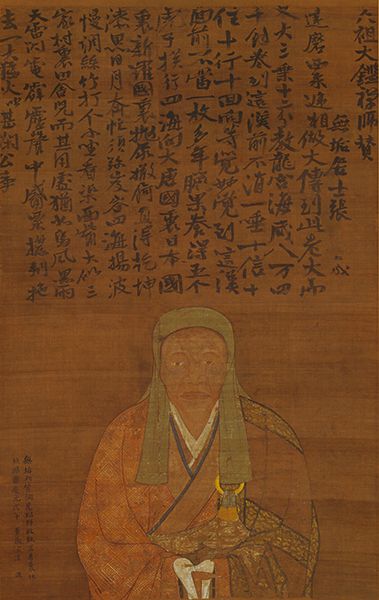
.jpg)
Meditation itself is the substance of wisdom; wisdom itself is the function of meditation.
Huineng is revered as the Sixth Patriarch of Chan (Zen) Buddhism, but most scholars regard the story of his life as largely legendary. In the traditional account, told in the Platform Sutra, he was an illiterate woodcutter from the south who won the robe of the Fifth Patriarch, Hongren, with a verse answering the head monk Shenxiu: where Shenxiu urged wiping the mirror of the mind clean, Huineng replied that Buddha-nature is always pure, so there is nowhere for dust to collect. The earliest surviving copy of the Platform Sutra dates from around 850, and some scholars think it was written by a later Chan monk.
Whatever its origins, the Platform Sutra is the only Chinese Buddhist discourse given the status of a sutra, and its themes of inherent enlightenment, no-thought and the unity of meditation and wisdom shaped all later Chan. Through his disciple Shenhui’s campaign, Huineng’s “Southern” school came to be accepted as the true line of Chan, and Chan’s influence reached the Neo-Confucians and beyond.
Key ideas
- Our own nature is Buddha-nature
- Everyone’s original nature is pure and already awakened; ignorance only obscures it. “If you are deluded in your own nature, Buddha is then a sentient being; if you are awakened in your own natures, sentient beings are then Buddhas.”
- Meditation and wisdom are one
- Meditation is not a means of reaching wisdom. The two are one, as a lamp and its light are one; Huineng called meditation the substance of wisdom and wisdom its function.
- No-thought (wunian)
- No-thought is not an empty mind or thoughtless behaviour, but attentive awareness that is “unstained in all environments”, responding to each situation without clinging to it.
- Neither sudden nor gradual
- The Dharma itself is neither sudden nor gradual; some people see it quickly and some slowly. Later Chan made “sudden awakening” its banner, but for Huineng awakening still called for a lifetime of practice.
- Tradition
- Chinese
- Region
- Tang dynasty China
- Schools
- Chan Buddhism
- Themes
- The self
Key works
- Platform Sutra of the Sixth Patriarch (Liuzu tanjing)
- Read free at Wikisource (in Classical Chinese, the later, expanded version of the text)
Sources
- John M. Thompson, Huineng (Hui-neng), Internet Encyclopedia of Philosophy
- Peter D. Hershock, Chan Buddhism, Stanford Encyclopedia of Philosophy